Last Updated: June 2026 | Author: Tarun | Read Time: 10 min
Key Takeaways
- Digital marketing is the promotion of products or services using the internet and digital channels like search engines, social media, email, and websites.
- India’s digital advertising market is projected to reach ₹69,856 crore by 2026 — making digital skills one of the most in-demand careers today.
- There are 10+ types of digital marketing — SEO, social media, content, email, paid ads, and more.
- You don’t need a huge budget to start — many digital marketing strategies work for free.
- AI is now deeply integrated into every digital marketing channel in 2026.
Introduction
Every business you see thriving online today has one thing in common — they understand digital marketing.
Whether it is a small bakery in Hyderabad getting orders through Instagram, or a startup in Bangalore ranking on page one of Google — all of it is powered by digital marketing.
But what exactly is digital marketing? How does it work? And why does it matter so much in 2026?
In this beginner’s guide, you will get a complete, no-fluff breakdown of digital marketing — what it is, the different types, how it works, and how you can get started today.
India is already the second largest online market in the world with over 900 million internet users. Digital advertising in India surged to ₹49,251 crore in 2024 — a 21.1% jump — and is forecast to reach ₹69,856 crore by 2026, representing 61% of total advertising spend in the country. This is not just a trend. This is a complete shift in how businesses connect with customers. And if you are not part of it, you are already falling behind.
Let us start from the very beginning.
What is Digital Marketing?
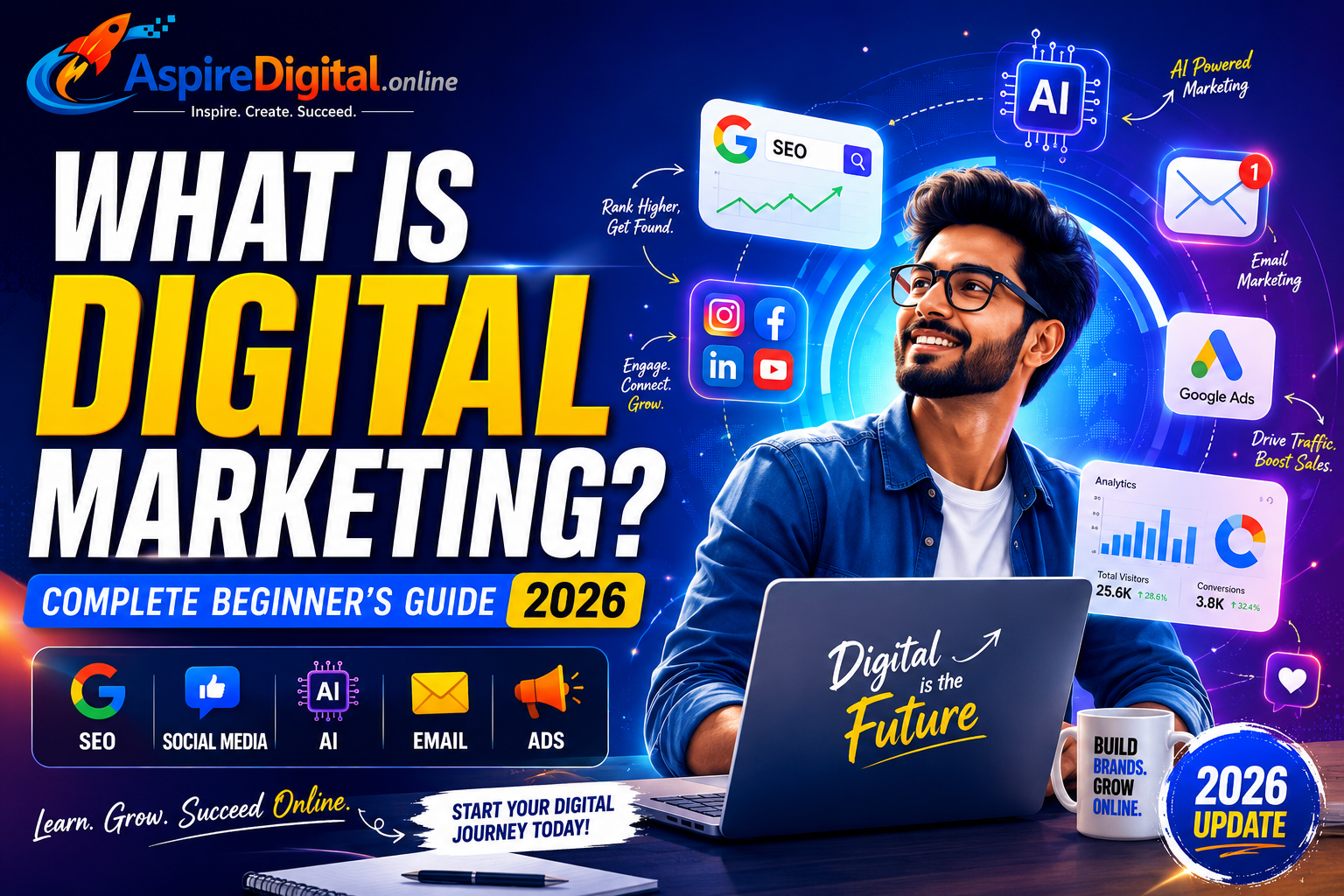
Digital marketing is the promotion of products, services, or brands through digital channels such as search engines, social media platforms, email, websites, and mobile apps — using the internet as the primary medium.
In simple terms: any marketing that happens online is digital marketing.
Think about the last time you searched something on Google and saw a result below an ad. That is digital marketing. The Instagram reel that made you want to buy a product? Digital marketing. The email with a discount code you received from your favourite brand? Also digital marketing.
Traditional marketing relied on TV, newspapers, hoardings, and radio. Digital marketing does the same thing — but online, with far better targeting, measurability, and cost-effectiveness.
Digital Marketing vs Traditional Marketing
| Feature | Traditional Marketing | Digital Marketing |
|---|---|---|
| Medium | TV, print, radio, hoardings | Internet, social media, email, search |
| Cost | High | Low to medium |
| Targeting | Broad audience | Laser-targeted by age, location, interest |
| Measurability | Difficult | Real-time tracking and analytics |
| Reach | Local or national | Global |
| Engagement | One-way | Two-way (comments, DMs, shares) |
| Speed | Weeks to months | Immediate results possible |
| Best for | Mass awareness | Leads, sales, conversions |
Why is Digital Marketing Important in 2026?
The world has moved online — and your customers are already there. Here is why digital marketing is not optional anymore:
1. Your customers are online. With over 900 million internet users in India alone, the audience you want to reach is spending hours every day on their phones, scrolling social media, watching videos, and searching Google.
2. It is far more affordable than traditional marketing. A well-written blog post can bring thousands of visitors for free. A targeted Facebook ad campaign can start at just ₹100 per day. You cannot buy a newspaper ad or TV commercial for that.
3. You can measure everything. Unlike a hoarding on a highway, digital marketing tells you exactly how many people saw your ad, how many clicked it, how many bought from you, and what your return on investment was.
4. AI is supercharging results in 2026. Artificial intelligence now powers everything from ad targeting to content creation to customer chat. Businesses using AI-powered digital marketing are growing significantly faster than those that are not.
5. Digital marketing creates careers. India’s digital marketing job market is booming. Companies are urgently hiring SEO specialists, social media managers, content writers, PPC experts, and digital marketing generalists — and paying handsomely for these skills.
Types of Digital Marketing (10 Core Channels)
Digital marketing is not just one thing. It is an umbrella term covering many different channels and strategies. Here are the 10 most important types:
1. Search Engine Optimization (SEO)
SEO is the process of optimizing your website and content so that it ranks higher in search engine results pages (SERPs) on Google, Bing, and other search engines — without paying for ads.
When someone searches “best digital marketing course in Hyderabad,” the websites that appear at the top have used SEO to get there. SEO includes on-page optimization (keywords, headings, content quality), technical SEO (site speed, mobile-friendliness), and off-page SEO (backlinks and authority).
Best for: Long-term organic traffic, brand authority, lead generation.
2. Content Marketing
Content marketing is creating and sharing valuable content — blog posts, videos, infographics, podcasts, case studies — to attract and engage your target audience. Instead of directly selling, you educate, inform, and build trust.
For example, a financial advisory firm might write detailed blog posts about how to save tax in India. People searching for that topic land on their blog, trust their expertise, and eventually become clients.
Best for: Building authority, organic traffic, long-term trust.
3. Social Media Marketing (SMM)
Social media marketing involves using platforms like Instagram, Facebook, LinkedIn, YouTube, X (Twitter), Pinterest, and Threads to build a brand, engage an audience, and drive traffic or sales.
In 2026, short-form video (Reels, Shorts) and community-driven content dominate social media. Social advertising is projected to overtake television as the largest advertising channel in India very soon.
Best for: Brand awareness, engagement, community building.
4. Pay-Per-Click Advertising (PPC)
PPC is a model where you pay only when someone clicks your ad. Google Ads, Meta Ads (Facebook and Instagram), LinkedIn Ads, and YouTube Ads all operate on this model.
PPC gives instant visibility. You can set up a Google Ad campaign today and start appearing at the top of search results within hours. Unlike SEO which takes months, PPC delivers immediate traffic.
Best for: Instant traffic, product launches, promotions, lead generation.
5. Email Marketing
Email marketing remains one of the highest ROI digital marketing channels in 2026 — delivering an average ROI of 38:1. This means for every ₹1 spent, businesses earn ₹38 back.
It involves building an email list and sending targeted messages — newsletters, promotional offers, automated follow-up sequences, and educational content — directly to subscribers’ inboxes.
Best for: Lead nurturing, customer retention, conversions, repeat sales.
6. Search Engine Marketing (SEM)
SEM is the broader category that includes both SEO (organic search) and PPC (paid search). It refers to all efforts to gain visibility in search engine results — both paid and unpaid.
In practice, most people use SEM to specifically refer to paid search advertising (Google Ads), while SEO covers the organic side.
Best for: Dominating search results with a combination of paid and organic strategies.
7. Influencer Marketing
Influencer marketing involves partnering with individuals who have a large, engaged following on social media or YouTube — and having them promote your product or service to their audience.
In India, influencer marketing has exploded across categories from beauty, fitness, and food to technology and finance. Micro-influencers (10,000 to 100,000 followers) often deliver better engagement and conversions than mega celebrities.
Best for: Brand awareness, product launches, niche audience targeting.
8. Affiliate Marketing
Affiliate marketing is a performance-based model where you earn a commission for promoting someone else’s product or service. When someone buys through your unique referral link, you earn a percentage of the sale.
For bloggers and content creators, affiliate marketing is one of the most popular ways to monetize a website. Amazon, Flipkart, and hundreds of SaaS companies run affiliate programs.
Best for: Passive income, blog monetization, performance-based partnerships.
9. Video Marketing
Video marketing uses video content to promote your brand, products, or services. YouTube, Instagram Reels, YouTube Shorts, and LinkedIn video are the dominant platforms in 2026.
Video is now the most consumed content format online. Studies show that viewers retain 95% of a message when they watch it in a video compared to just 10% when reading text.
Best for: Brand storytelling, product demos, tutorials, YouTube SEO.
10. WhatsApp Marketing
Especially powerful in India, WhatsApp marketing involves using WhatsApp Business to communicate directly with customers, send broadcasts, run automated conversations, and drive sales through a platform that almost every Indian smartphone user already has installed.
Click-to-WhatsApp ads on Facebook and Instagram are one of the fastest-growing ad formats in India right now.
Best for: Direct customer communication, local businesses, high open-rate promotions.
How Does Digital Marketing Work?
Digital marketing works by following a journey — from making someone aware of your brand, to converting them into a paying customer. This is called the marketing funnel:
Stage 1 — Awareness: The customer first discovers you. This happens through a Google search result, an Instagram reel, a YouTube video, or a word-of-mouth share.
Stage 2 — Interest: They want to know more. They visit your website, read your blog, watch your content, or follow you on social media.
Stage 3 — Consideration: They are thinking about buying but comparing options. Good content, testimonials, and email sequences help here.
Stage 4 — Conversion: They take action — make a purchase, fill a form, book a call, or sign up for your service.
Stage 5 — Retention: You keep them engaged through email, social media, WhatsApp, and loyalty programs so they come back and buy again.
Every digital marketing channel plays a specific role in this funnel. SEO brings awareness. Content marketing builds interest. Email marketing nurtures consideration. PPC drives conversions. Social media supports all stages.
Digital Marketing in 2026 — What Has Changed?
Digital marketing in 2026 is fundamentally different from what it was even three years ago. Here is what is new:
AI is everywhere. AI tools now help marketers create content, write ad copy, analyse data, automate customer interactions, personalise email sequences, and optimise campaigns in real time. Businesses that are not using AI in their marketing are operating at a significant disadvantage.
Search is no longer just Google. People are now searching on ChatGPT, Perplexity, and Google Gemini. When you ask these AI tools a question, they generate an answer and cite sources — meaning your content needs to be optimised not just for Google, but also for AI-generated responses. This is called GEO (Generative Engine Optimization).
Google AI Overview is changing how search results look. Google now shows an AI-generated summary box at the top of many search results. If your content is not structured to appear in this box, you are losing visibility even if you rank on page one.
Voice search is growing rapidly. More Indians are using voice search on their phones in regional languages and English. Content now needs to be optimised to answer natural, spoken questions — not just typed keywords.
Short-form video dominates. Reels, Shorts, and Clips are the fastest-growing content formats across platforms. Brands that are not producing short-form video are invisible to an entire generation of buyers.
How to Get Started with Digital Marketing (Step-by-Step for Beginners)
Starting with digital marketing can feel overwhelming because there are so many channels. Here is a simple roadmap to get started without confusion:
Step 1 — Choose your focus. Do not try to do everything at once. Pick one primary channel — SEO, social media, or content marketing — and master it before adding more.
Step 2 — Build your online presence. Start a website or blog (WordPress is the best platform for beginners), set up your social media profiles, and make sure your Google Business Profile is complete if you have a local business.
Step 3 — Learn keyword research. Keyword research helps you understand what your target audience is searching for. Use free tools like Google Keyword Planner or Ubersuggest to find topics to write about or target in your ads.
Step 4 — Create valuable content consistently. Write blog posts, create Reels, shoot YouTube videos, or send email newsletters — whichever format suits you. Consistency beats perfection every time.
Step 5 — Track your results. Set up Google Analytics 4 and Google Search Console on your website from day one. Data tells you what is working and what needs improvement.
Step 6 — Learn and improve continuously. Digital marketing changes fast. Follow industry blogs like AspireDigital.online, take free courses on Google Skillshop and HubSpot Academy, and keep experimenting.
Common Digital Marketing Mistakes Beginners Make
Avoid these mistakes that cost beginners time, money, and results:
Trying to be on every platform at once. Focus on one or two channels first and do them well. Spreading yourself thin leads to mediocre results everywhere.
Ignoring SEO. Many beginners focus only on social media and ignore Google search. SEO builds long-term, compounding traffic that keeps working even when you are not.
Not building an email list. Social media algorithms change overnight. Your email list is an asset you own and control. Start building it from day one.
Creating content without a strategy. Posting randomly without a content plan leads to no results. Every piece of content should serve a purpose in your marketing funnel.
Expecting overnight results. Digital marketing is not a get-rich-quick scheme. SEO takes 3–6 months. Building a social media following takes time. Stay consistent and the results will come.
Not measuring results. If you are not tracking metrics, you are guessing. Set up analytics and review your numbers weekly.
Expert Tips for Digital Marketing Success in 2026
Here are proven tips from working in digital marketing with 30+ websites built and clients served across industries:
Tip 1 — Build topical authority, not just traffic. Instead of writing random blog posts, create a cluster of content around one topic. Cover it from every angle. Google and AI systems reward websites that demonstrate deep expertise on a specific subject.
Tip 2 — Optimise for AI, not just Google. In 2026, your content must be structured so that AI tools like ChatGPT and Google Gemini can cite and reference it. This means clear, direct answers, structured headings, data-backed claims, and a strong author bio that shows expertise.
Tip 3 — Use video to explain, and text to rank. Video builds trust and engagement. Text content (blogs) builds search visibility. The most effective brands in 2026 use both together — they repurpose blog posts into Reels and videos into transcribed blog content.
Tip 4 — WhatsApp is India’s most underused marketing channel. Every Indian has WhatsApp. Yet most businesses in India are not using it strategically. Set up WhatsApp Business, create broadcast lists, and run Click-to-WhatsApp ads — your open rates will blow email out of the water.
Tip 5 — Invest in personal branding. In a world flooded with AI-generated content, human trust is the scarcest resource. Your name, face, story, and expertise are your competitive advantage. Build your personal brand alongside your business brand.
Digital Marketing vs Digital Advertising — What is the Difference?
A common point of confusion for beginners: digital marketing and digital advertising are not the same thing.
Digital marketing is the broad umbrella — it includes all organic and paid activities: SEO, content marketing, social media, email, PR, community building, and more.
Digital advertising is a subset of digital marketing — it specifically refers to paid promotions: Google Ads, Meta Ads, YouTube Ads, LinkedIn Ads, and similar paid channels.
Think of digital advertising as one tool inside the larger digital marketing toolbox.
Frequently Asked Questions (FAQ)
Q1. What is digital marketing in simple words? Digital marketing is any form of marketing that uses the internet or digital devices. This includes SEO, social media posts, email campaigns, YouTube videos, Google Ads, and WhatsApp promotions — all aimed at reaching your target customer online.
Q2. Is digital marketing a good career in India in 2026? Yes, digital marketing is one of the fastest-growing career fields in India. With digital ad spend projected to cross ₹69,856 crore by 2026 and every business needing an online presence, demand for digital marketing professionals is at an all-time high.
Q3. How much does digital marketing cost? Digital marketing can be free (SEO, organic social media, content marketing) or paid (Google Ads, Meta Ads). Small businesses can start with a budget of ₹5,000 to ₹10,000 per month for paid ads, while organic strategies cost only time and effort.
Q4. Can a beginner learn digital marketing on their own? Absolutely. There are excellent free resources available — Google Skillshop, HubSpot Academy, Meta Blueprint, and blogs like AspireDigital.online. With consistent learning and practice, a beginner can become job-ready in 3–6 months.
Q5. Which type of digital marketing is best for beginners? For beginners, content marketing and SEO are the best starting points. They cost little to nothing, build long-term value, and teach you the fundamentals of understanding your audience — which applies to every other digital marketing channel.
Q6. What is the difference between SEO and SEM? SEO (Search Engine Optimization) is the process of ranking your website organically in search results without paying. SEM (Search Engine Marketing) is the broader category that includes both SEO and paid search ads (like Google Ads).
Q7. How is digital marketing different in 2026 compared to earlier years? The biggest changes in 2026 are the rise of AI in search (GEO, AI Overview), the dominance of short-form video, and the integration of AI tools into every marketing channel. Marketers now also need to optimise content for AI assistants like ChatGPT and Google Gemini — not just Google’s blue links.
Conclusion
Digital marketing is no longer a competitive advantage — it is a necessity. Every business, every professional, and every creator who wants to grow in 2026 needs to understand how digital marketing works and how to use it strategically.
The good news? You do not need a massive budget or a big team to get started. You need the right knowledge, a clear strategy, and consistent execution.
This blog — AspireDigital.online — exists to give you exactly that. Every week, we publish in-depth guides covering everything from SEO and social media to AI marketing and email — all written from real experience of building and marketing 30+ websites across industries.
Bookmark this site. Come back every day. And start building your digital marketing skills — one blog post at a time.
About the Author
Tarun is a Digital Marketing Specialist and WordPress Developer with 3+ years of hands-on experience helping businesses grow online. He has built 30+ real-world websites and delivered digital marketing services across industries including healthcare, hospitality, enterprise services, visa consulting, wellness, and more. Through AspireDigital.online, Tarun shares practical, no-fluff digital marketing strategies to help creators, freelancers, and business owners thrive in the digital world.
🔗 Portfolio | Instagram | LinkedIn