Last Updated: June 2026 | Author: Tarun | Read Time: 13 min
Table of Contents
- Key Takeaways
- Introduction
- What is E-E-A-T in SEO?
- E — Experience: The Newest and Most Powerful Signal
- E — Expertise: Demonstrating Deep Knowledge
- A — Authoritativeness: Building Recognition Beyond Your Site
- T — Trustworthiness: The Foundation Everything Else Sits On
- Is E-E-A-T a Direct Google Ranking Factor?
- E-E-A-T and YMYL: Why Some Niches Face Higher Standards
- How E-E-A-T Affects AI Overview and GEO Visibility
- 8 Proven Ways to Improve Your E-E-A-T in SEO Signals
- Common E-E-A-T Mistakes That Hurt Rankings
- How to Measure if Your E-E-A-T Efforts Are Working
- E-E-A-T Signals — Complete Reference Table
- Expert Tips from Building 30+ Websites
- Frequently Asked Questions
- Conclusion
Key Takeaways
- E-E-A-T in SEO stands for Experience, Expertise, Authoritativeness, and Trustworthiness — Google’s quality evaluation framework that shapes rankings across all types of content.
- Generic content farms lost up to 60% of traffic after the December 2025 Core Update, while sites demonstrating real experience and expertise saw 23% ranking gains.
- E-E-A-T is not a direct ranking signal with a measurable score — it is a quality framework reflected through dozens of algorithmic signals that Google evaluates together.
- The March 2026 Core Update was one of the most volatile on record — nearly 25% of top-10 pages fell out of the top 100 entirely, with E-E-A-T gaps being the primary cause.
- Pages cited in Google AI Overviews consistently share one characteristic: strong, demonstrable E-E-A-T signals across content, authorship, and site trust.
Introduction
In 2026, you can have perfect keyword placement, a fast website, and dozens of backlinks — and still lose rankings to a competitor who does one thing better: demonstrates genuine trustworthiness and real expertise.
That is the power of E-E-A-T in SEO. It is not a checkbox. It is not a plugin setting. It is the deeper question Google is asking about every single piece of content on the internet: Is this written by someone who actually knows what they are talking about? Can we trust this source enough to show it to our users?
After the March 2026 Core Update — one of the most volatile in Google’s history, with nearly 25% of top-10 pages falling out entirely — E-E-A-T signals have become the clearest dividing line between sites that thrive and sites that struggle.
In this complete guide, you will learn exactly what E-E-A-T in SEO is, how each of its four components works, and the 8 proven steps you can take right now to build the kind of trust that Google rewards with top rankings. If you missed our guide on Google’s top SEO ranking factors, read that first for the full context on where E-E-A-T fits in.
What is E-E-A-T in SEO?
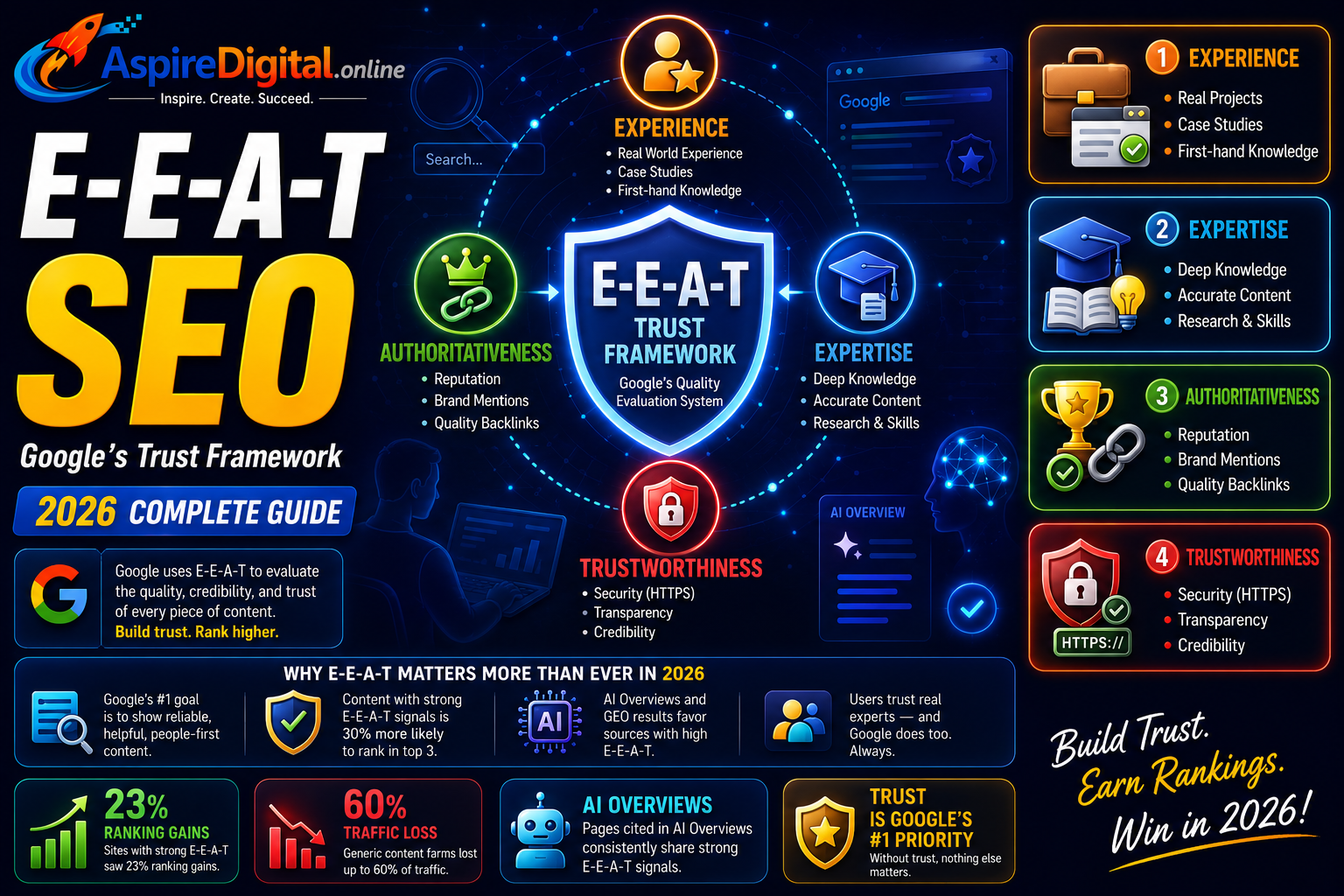
E-E-A-T in SEO stands for Experience, Expertise, Authoritativeness, and Trustworthiness. It is the quality evaluation framework Google uses to assess whether content is credible, reliable, and genuinely useful — and it applies to every type of website and content, not just health or finance topics.
Google’s Search Quality Rater Guidelines — a document Google uses to train human evaluators who assess search results — defines E-E-A-T as the core criteria for distinguishing high-quality content from low-quality content. These human evaluations do not directly affect rankings, but they directly inform how Google’s algorithms are developed and tuned.
E-E-A-T was originally introduced as E-A-T (without the first “E” for Experience). Google added Experience as the fourth component in December 2022 — a direct response to the explosion of AI-generated content that could appear knowledgeable without ever having actually done, tested, or lived the thing being written about.
Here is how the full framework breaks down:
- Experience — Has the author personally done, used, tested, or lived what they are writing about?
- Expertise — Does the author demonstrate deep, accurate knowledge of the subject?
- Authoritativeness — Is the author and website recognized as a credible, trusted source by others in the field?
- Trustworthiness — Is the content accurate, honest, transparent, and safe? Is the site technically secure and clearly identifiable?
Trustworthiness is the most important of the four — Google’s own guidelines explicitly state that a page that cannot be trusted has low E-E-A-T regardless of how much experience or expertise the author may have.
E — Experience: The Newest and Most Powerful Signal
Experience is the newest and — in 2026 — arguably the most powerful E-E-A-T signal. It asks whether the content creator has firsthand, real-world involvement with the topic. This is the signal that separates genuine human expertise from AI-generated content that sounds knowledgeable but has never actually done the thing it is describing.
Under the old E-A-T model, a well-researched article from a credentialed expert was enough to signal quality. Under E-E-A-T, Google also wants evidence that the author has personally engaged with the topic in the real world — not just researched it.
Consider two articles about “how to set up a WordPress website.” One is written by someone who has built 30+ WordPress websites for real clients. The other is a well-researched summary written by someone who has never actually built a site. Both may cover the same steps. But only the first one will include the real-world details that matter: which hosting issues actually come up, which plugins conflict, what the typical beginner mistakes are, and what shortcuts actually work.
That difference — firsthand lived experience versus second-hand research — is exactly what Google is trying to detect and reward with the Experience signal.
How to Demonstrate Experience in Your Content
- Include original case studies, personal project results, and real-world examples from your own work
- Show original photos, screenshots, or videos from your actual experience
- Mention specific details that only someone who has actually done the thing would know
- Discuss failures, challenges, and lessons learned — not just polished success stories
- Reference the specific tools, clients, or projects you have worked on (where appropriate)
- Use first-person language naturally to reflect genuine personal involvement
E — Expertise: Demonstrating Deep Knowledge
Expertise in E-E-A-T in SEO refers to the depth, accuracy, and demonstrated competence of the content itself. It asks: does this author clearly understand this topic at a level that qualifies them to be writing about it?
Expertise is demonstrated through the content itself — the level of depth it goes into, the accuracy of its claims, the nuance it brings to complex topics, and the degree to which it covers areas that casual observers would miss. A surface-level overview signals low expertise. A comprehensive, nuanced guide with specific technical details signals high expertise.
In 2026, Google’s AI systems — including BERT and MUM — are sophisticated enough to detect the difference between content that reflects deep understanding and content that paraphrases commonly available information. Long-form, well-researched content that covers a topic comprehensively consistently outperforms shorter, shallower alternatives — not because of word count, but because of the depth of knowledge it demonstrates.
How to Demonstrate Expertise in Your Content
- Cover topics comprehensively — address the sub-questions and nuances, not just the surface level
- Cite authoritative external sources, studies, and data to support your claims
- Include detailed author bios with credentials, professional experience, and links to professional profiles
- Use Author Schema markup to connect content to a real, credentialed person in structured data
- Publish in-depth topic clusters that demonstrate sustained, focused expertise in your niche — not random scattered posts across unrelated topics
- Keep content updated — outdated information signals declining expertise
A — Authoritativeness: Building Recognition Beyond Your Site
Authoritativeness is about how others perceive and recognize you within your field — not what you claim about yourself. It is external validation. It comes from other trusted sources acknowledging your work, citing your content, linking to your pages, and mentioning your brand as a credible voice in your niche.
This is why authority cannot be manufactured quickly. It grows over time through consistent expertise demonstration, relationship building with others in your field, and producing content that other people genuinely find valuable enough to reference.
The most powerful authority signals include backlinks from reputable sites in your niche, mentions in established publications, being cited in other expert articles, guest posts on respected platforms, speaking at events, and having your brand recognized as an entity that Google understands — rather than an anonymous website publishing generic content.
Google’s 2024 Content Warehouse API leak revealed the siteAuthority signal — a site-wide link popularity score that operates as a modernized PageRank applied at the domain level. This confirmed that authority is evaluated not just at the individual page level, but at the domain level — meaning every page you publish contributes to (or detracts from) your overall domain authority.
How to Build Authoritativeness
- Earn backlinks from topically relevant, high-quality websites — not generic directories
- Guest post on respected sites in your industry with real editorial standards
- Publish original research, data studies, or proprietary insights that others can cite and reference
- Build a recognizable personal or brand identity that becomes a named entity Google understands
- Get mentioned in established publications, podcasts, and industry communities
- Create topical content clusters that demonstrate sustained authority in a specific subject area
T — Trustworthiness: The Foundation Everything Else Sits On
Trustworthiness is the most critical E-E-A-T signal in 2026. Google’s own guidelines state that a page with low trust has low E-E-A-T — regardless of how much experience or expertise it may otherwise demonstrate. Trust is the foundation that determines whether every other signal counts.
Trustworthiness goes beyond content accuracy. It encompasses the technical security of your website, the transparency of who is behind the content, the honesty of your claims, the absence of deceptive practices, and the overall reliability of the user experience you provide.
For content that falls under YMYL (Your Money or Your Life) categories — health, finance, legal, safety — trust standards are held to an even higher level. But in 2026, with AI-generated misinformation flooding the internet, Google has raised its trust expectations for all content types, not just YMYL.
How to Build Trustworthiness
- Ensure your site runs on HTTPS — an insecure site signals low trust immediately
- Have a complete, transparent About page that clearly identifies who is behind the site
- Add a Privacy Policy, Terms of Service, and Contact page — these are trust signals, not just legal requirements
- Display clear author information on every post, including name, photo, bio, and credentials
- Cite your sources — link to authoritative references for statistics and claims
- Keep information accurate and up to date — show “Last Updated” dates on posts
- Earn and display genuine user reviews, testimonials, and social proof
- Respond to user comments and questions — active engagement signals a real, trustworthy entity behind the site
Is E-E-A-T a Direct Google Ranking Factor?
No — E-E-A-T is not a direct ranking factor with a measurable score that Google plugs into its algorithm. There is no “E-E-A-T score” that appears in your Search Console or any SEO tool. However, the qualities E-E-A-T represents are measured indirectly through dozens of algorithmic signals that collectively determine your rankings.
This distinction matters because it changes how you approach E-E-A-T. You cannot optimize for E-E-A-T the same way you optimize a title tag or page speed. You build E-E-A-T by consistently demonstrating genuine experience and expertise through your content, earning recognition and backlinks from respected sources, and maintaining a technically trustworthy and transparent website over time.
Think of E-E-A-T as the context that decides how much your other SEO signals count. Strong keyword optimization on a page with weak trust signals may not rank. The same keyword optimization on a page with strong E-E-A-T signals gets significantly more ranking leverage from those same technical and on-page factors.
As one SEO expert put it: “In 2026, E-E-A-T is not a guideline — it is a gatekeeper. Content without visible experience, ownership, and trust signals will increasingly struggle to compete, no matter how well it is technically optimized.”
E-E-A-T and YMYL: Why Some Niches Face Higher Standards
YMYL stands for “Your Money or Your Life” — a category Google uses to identify content that could significantly impact a user’s health, financial stability, legal rights, or safety. YMYL content is held to much higher E-E-A-T standards because the consequences of poor or misleading information are far more serious.
YMYL categories include medical and health advice, financial guidance and investment recommendations, legal information, safety instructions, and major life decision topics like childcare or housing. For these topics, Google requires exceptionally strong expertise and trust signals — it is not enough to write well-researched content. The author must have genuine, verifiable credentials in the relevant field.
For a blog like AspireDigital, which covers digital marketing and technology, the E-E-A-T standards are lower than for a medical or financial blog — but they are not zero. Even for non-YMYL content, E-E-A-T signals now differentiate quality content from generic summaries as AI-generated content continues to flood the internet.
The practical implication: if you plan to expand AspireDigital into health or finance topics (as planned), you will need to pay even more careful attention to author credentials, source citations, and content accuracy in those specific categories.
How E-E-A-T Affects AI Overview and GEO Visibility
In 2026, E-E-A-T in SEO signals are not just important for traditional Google rankings — they are the primary filter that determines which sources get cited in Google AI Overviews, ChatGPT, Perplexity, and other AI-generated search responses.
Google AI Overviews now appear on approximately 26% of US searches and cut click-through rates on the number one organic result by roughly 60%. This means that for a growing percentage of searches, being cited in the AI Overview generates more visibility than ranking in position one of traditional results.
The pages that get cited in AI Overviews consistently share one characteristic: strong, demonstrable E-E-A-T signals. AI systems are designed to prioritize sources that are trustworthy, credible, and authoritative — the same qualities Google’s E-E-A-T framework measures. A data-backed study from 2026 confirmed that 92.36% of AI citations come from pages already ranking on page one of traditional search — meaning traditional SEO and E-E-A-T are the entry ticket to AI visibility as well.
To maximize your chances of being cited in AI-generated results, your content must demonstrate real authorship, include verifiable data with cited sources, provide clear structured answers, and come from a site with a strong overall trust and authority profile — all of which are direct E-E-A-T signals.
8 Proven Ways to Improve Your E-E-A-T in SEO Signals
Here are the 8 most impactful, practical steps to build genuine E-E-A-T signals on your website — based on what consistently works across real websites:
1. Add a Detailed, Credible Author Bio to Every Post
Every blog post on your site should have a visible author bio — not just a name, but a bio that includes your credentials, real-world experience, relevant projects or clients you have worked with, and links to professional profiles like LinkedIn and your portfolio. In 2026, a detailed author bio paired with Author Schema markup is essentially non-negotiable for E-E-A-T. It ties your content to a real, identifiable, credentialed person — exactly what Google’s systems are looking for.
2. Build a Complete, Transparent About Page
Your About page is one of the highest-value E-E-A-T pages on your entire website. It should clearly explain who you are, what your real-world experience is, what makes you qualified to write about your topics, and how readers can reach you. A strong About page builds trust with both users and Google’s quality evaluation systems. Generic, vague About pages are a significant missed opportunity.
3. Cite Authoritative Sources in Every Post
Every factual claim, statistic, or data point in your content should be linked to a credible source — a study, an official report, a recognized industry authority, or a reputable publication. This does two things: it signals to Google that your content is research-backed and accurate, and it signals to AI systems that your content is citable and trustworthy enough to reference in AI-generated answers.
4. Include Original Experience, Data, and Case Studies
The most powerful E-E-A-T signal you can demonstrate is original firsthand experience. Include case studies from your own client work, original data from your own testing, real screenshots and photos, and honest assessments based on direct personal involvement. AI systems cannot replicate genuine experience — making this your most defensible competitive advantage in the age of AI-generated content.
5. Build Backlinks from Topically Relevant Sites
Authoritativeness is built externally — through other trusted sites recognizing and linking to your content. Focus on earning backlinks from sites in your specific niche, not generic directories or unrelated blogs. Guest posts on respected industry sites, original research that others reference, and getting featured in established publications all build the kind of authority that compounds over time and is nearly impossible for competitors to replicate quickly.
6. Keep Content Fresh and Updated
Outdated content is a trust signal problem. In a fast-moving field like digital marketing, content that still references 2022 statistics or outdated practices signals declining expertise and low trustworthiness. Add “Last Updated” dates visibly on your posts. Review and refresh your most important content regularly — Google rewards freshness, and AI systems prioritize recently updated, accurate sources.
7. Implement Author Schema and Organization Schema
Schema markup is the technical layer that connects your content to real people and organizations in Google’s structured data. Implementing Author Schema on your posts tells Google exactly who wrote the content, what their credentials are, and where their professional profiles can be verified. Organization Schema tells Google who operates the website. These markup signals directly strengthen the Expertise and Trustworthiness components of E-E-A-T at the code level — not just the content level. RankMath makes both of these straightforward to implement without coding.
8. Build a Strong Review and Brand Mention Profile
Google actively indexes reviews from Google Business Profile, industry platforms, and third-party review sites. A strong, genuine review profile — with authentic, detailed customer feedback — builds the Trust signals that influence both local and general rankings. Beyond reviews, brand mentions across the web (even without backlinks) signal to Google that your brand is a real, recognized entity. Active engagement on LinkedIn, responding to comments on your blog, and participating in your industry community all contribute to a positive brand signal profile.
Common E-E-A-T Mistakes That Hurt Rankings
Publishing content with no identified author. Anonymous content is a significant E-E-A-T red flag. Every post needs a clearly identified, credentialed human author. “Admin” or “Staff Writer” with no bio is almost as bad as no author at all.
Fabricating credentials or author personas. Creating fake author personas, inventing credentials, or using stock photos for “team members” that do not exist are deceptive practices Google is increasingly sophisticated at detecting. The penalty if caught is severe and long-lasting.
Adding author bios to low-quality content and expecting it to fix the problem. E-E-A-T signals should reflect genuine quality, not compensate for lacking it. A detailed author bio on a thin, poorly-researched post does not improve rankings — it just adds decoration to a weak page. Fix the content first.
Treating E-E-A-T as a one-time task. E-E-A-T compounds over time through consistency. It is not a one-time audit and fix. Content ages, information becomes outdated, authority must be maintained through continued activity and publishing. Build E-E-A-T maintenance into your content operations as an ongoing practice.
Ignoring technical trust signals. A site without HTTPS, with no Privacy Policy or Contact page, with no clear information about who owns or operates it, automatically signals low trust — regardless of how good the content is. Technical trust signals are the foundation E-E-A-T sits on.
Publishing generic AI content without human expertise. AI-generated content can synthesize information and appear knowledgeable, but it cannot have genuine firsthand experience. Pure AI content without human value-add — real expertise, original examples, honest assessments — consistently underperforms in Google’s Helpful Content evaluations and is explicitly what E-E-A-T’s Experience signal is designed to filter out.
How to Measure if Your E-E-A-T Efforts Are Working
There is no “E-E-A-T score” in any tool. But you can track the indirect signals that reflect E-E-A-T improvement:
Ranking positions for key topics. Track your rankings in Google Search Console for your primary target keywords. Rising positions over 3–6 months after E-E-A-T improvements signal that Google is increasingly trusting your content.
Click-through rate (CTR). A higher CTR on your search results means your title, meta description, and brand are building trust with searchers — a direct user trust signal Google monitors through its navBoost system.
Time on page and scroll depth. Track these in Google Analytics 4. If users are spending more time on your content and scrolling further after E-E-A-T improvements, it means your content is genuinely engaging the people who find it — which feeds positive engagement signals back to Google.
Backlink acquisition rate. Track new backlinks in Google Search Console or a tool like Ahrefs. A rising rate of new backlinks from relevant sites signals growing authoritativeness.
AI citation visibility. Manually search your key topics in Google AI Mode, ChatGPT, and Perplexity. Note whether your site starts appearing in generated responses. This is a direct indicator that your E-E-A-T and GEO signals are strengthening your credibility with AI systems.
E-E-A-T Signals — Complete Reference Table
| E-E-A-T Component | What Google Evaluates | Key Signals to Build | Where It Shows Up |
|---|---|---|---|
| Experience | Firsthand real-world involvement with the topic | Original photos, case studies, personal anecdotes, real project examples | Content body, author bio |
| Expertise | Depth, accuracy, and demonstrated competence | Comprehensive content, cited sources, author credentials, Author Schema | Content depth, author bio, schema markup |
| Authoritativeness | Recognition and reputation from external sources | Quality backlinks, brand mentions, guest posts, original research | Backlink profile, brand mentions, domain authority |
| Trustworthiness | Accuracy, transparency, honesty, technical security | HTTPS, About/Contact pages, Privacy Policy, updated dates, reviews | Technical setup, site pages, user signals |
Expert Tips from Building 30+ Websites
Tip 1 — Your About page is your most important E-E-A-T asset. After building and marketing 30+ websites for real clients, the single most consistent pattern I have seen is this: websites with detailed, credible About pages consistently rank better and recover faster from algorithm updates than sites with generic or missing About pages. Invest real time in making your About page specific, personal, and genuinely informative about who you are and what you have actually done.
Tip 2 — Write about what you have actually done, not just what you have researched. The best-performing content on every website I have worked on is the content that draws from real client work, real results, and real-world lessons. For digital marketing specifically, this means referencing actual campaigns, actual client results (anonymized if needed), and actual tools you use day-to-day. Readers and Google’s systems both respond to specificity that could only come from direct experience.
Tip 3 — Build E-E-A-T proactively before you need it. E-E-A-T compounds over time — it is much easier to maintain strong E-E-A-T than to rebuild it after an algorithm update hits. Start building your author credentials, backlink profile, and trust signals from your very first post, not as a recovery tactic after rankings drop.
Tip 4 — Schema markup is the hidden E-E-A-T multiplier most bloggers ignore. Most WordPress bloggers set up RankMath and never use its schema features beyond the basics. But implementing Author Schema, Organization Schema, and Article Schema properly connects your content to real, verifiable entities at the code level — giving Google’s systems a structured, machine-readable confirmation of your expertise and authority signals. RankMath Pro makes this straightforward. This is one of the highest-leverage technical E-E-A-T improvements available to any site.
Tip 5 — In competitive niches, your E-E-A-T is your moat. Great content can be copied. Keywords can be targeted by anyone. But genuine firsthand experience, real client work, authentic credentials, and a track record of original insights built over years cannot be replicated overnight. In a world where AI tools make it trivially easy for anyone to produce surface-level content on any topic, your real expertise and documented experience are the most defensible competitive advantages you have.
Frequently Asked Questions
What does E-E-A-T stand for in SEO?
E-E-A-T stands for Experience, Expertise, Authoritativeness, and Trustworthiness. It is Google’s quality evaluation framework used to assess whether content is credible, reliable, and genuinely useful. The first “E” for Experience was added in December 2022, specifically to distinguish content backed by real firsthand involvement from AI-generated summaries that sound knowledgeable but lack genuine experience.
Is E-E-A-T a direct Google ranking factor?
No. E-E-A-T is not a direct ranking signal with a measurable score. There is no “E-E-A-T score” in Google’s algorithm or in any SEO tool. However, the qualities E-E-A-T represents are measured indirectly through dozens of algorithmic signals — backlinks, author credentials, content quality, user engagement, technical trust signals, and more — that collectively determine rankings.
How do I improve E-E-A-T on my website?
The 8 most impactful steps are: add detailed author bios to every post, build a transparent About page, cite authoritative sources, include original case studies and real-world examples, earn backlinks from relevant sites, keep content fresh and updated, implement Author and Organization Schema markup, and build a strong review and brand mention profile.
Does E-E-A-T apply to all websites or only health and finance sites?
E-E-A-T applies to all websites and all content types. While health, finance, and legal sites (YMYL categories) face higher E-E-A-T standards due to the potential harm of misinformation, Google evaluates E-E-A-T signals across all niches. In 2026, with AI-generated content flooding the internet, E-E-A-T has become a differentiator for all content types — not just high-stakes topics.
How long does it take to see results from E-E-A-T improvements?
E-E-A-T is a long-term investment. Authority and trust signals build over months and years. However, experience and expertise can be demonstrated immediately through your content if you genuinely have them. Technical trust signals (HTTPS, About page, author bios) can show impact within weeks. Backlink-driven authoritativeness typically takes 3–12 months to compound meaningfully in rankings.
Can AI-generated content have good E-E-A-T?
AI-generated content can demonstrate expertise (accuracy and depth) and trustworthiness (factual accuracy, cited sources). But it fundamentally cannot have genuine Experience — because Experience requires firsthand real-world involvement that AI systems cannot have. Content that combines AI efficiency with genuine human experience signals — edited by a real expert who adds original examples, honest assessments, and personal insights — can perform well. Pure AI content without human value-add consistently underperforms.
What is the most important E-E-A-T signal in 2026?
Trustworthiness — Google’s own guidelines state that a page with low trust has low E-E-A-T regardless of all other signals. Without a secure site, transparent authorship, accurate content, and honest practices, no amount of expertise or authority can compensate. After trust, Experience has become the fastest-growing differentiator in 2026 — specifically because it is the one signal AI systems cannot replicate.
Conclusion
E-E-A-T in SEO is not a trend or a temporary algorithm priority. It is Google’s long-term answer to the fundamental question of what makes information trustworthy enough to show to millions of searchers every day — and in 2026, that question has never been more critical.
The March 2026 Core Update proved this with data: generic content farms lost massive traffic while sites with real experience, genuine expertise, and strong trust signals gained 23% in rankings. The pattern is clear and consistent across every major Google update of the past three years.
The good news for creators like you is that real firsthand experience — the kind that comes from actually building 30+ websites, actually running digital marketing campaigns for real clients, actually testing strategies and learning from what fails — is the one E-E-A-T signal that AI cannot fake, competitors cannot copy overnight, and algorithm updates consistently reward.
Build E-E-A-T into every piece of content you publish. Make it visible in your author bio, your About page, your case studies, your source citations, and your schema markup. The investment compounds — and the moat it creates around your content is one that grows stronger every time Google updates its algorithm.
Next up on AspireDigital, we go deep into the Search Generative Experience and how AI is changing SEO. And if you have not yet read our complete guide on the 4 types of SEO, that is the perfect complement to everything covered here.
About the Author
Tarun is a Digital Marketing Specialist and WordPress Developer with 3+ years of hands-on experience helping businesses grow online. He has built 30+ real-world websites and delivered digital marketing services across industries including healthcare, hospitality, enterprise services, visa consulting, wellness, and more. Through AspireDigital.online, Tarun shares practical, no-fluff digital marketing strategies to help creators, freelancers, and business owners thrive in the digital world.
🔗 Portfolio | Instagram | LinkedIn