Last Updated: June 2026 | Author: Tarun | Read Time: 13 min
Table of Contents
- Key Takeaways
- Introduction
- What is Black Hat SEO?
- How Google Detects Black Hat SEO in 2026
- Tactic 1 — Keyword Stuffing
- Tactic 2 — Cloaking
- Tactic 3 — Private Blog Networks (PBNs)
- Tactic 4 — Buying Backlinks
- Tactic 5 — Doorway Pages
- Tactic 6 — Hidden Text and Invisible Links
- Tactic 7 — Content Scraping and Article Spinning
- Tactic 8 — Scaled AI Content Spam (AI-Washing)
- Tactic 9 — Negative SEO Against Competitors
- Tactic 10 — Sneaky Redirects
- Real-World Penalty Case Studies
- Types of Google Penalties Explained
- How to Recover from a Black Hat SEO Penalty
- Black Hat vs White Hat vs Grey Hat — Full Comparison
- Mistakes That Lead Sites into Black Hat Territory Accidentally
- Expert Tips to Protect Your Site
- Frequently Asked Questions
- Conclusion
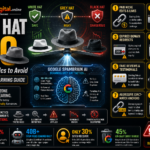
Key Takeaways
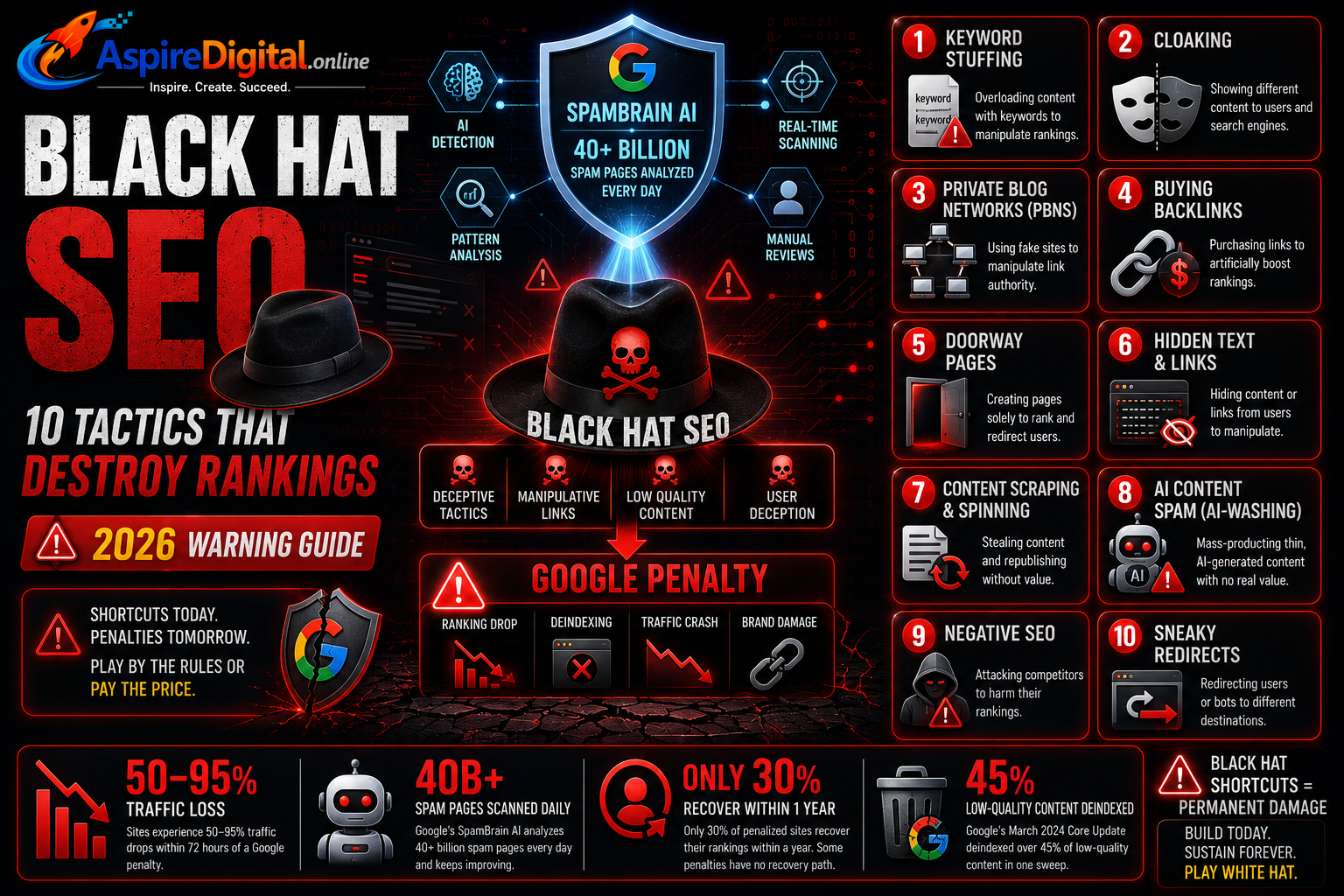
- Black hat SEO tactics can trigger 50–95% traffic drops within 72 hours of a Google penalty — and analysis of penalized businesses shows 40% close within six months of a manual action.
- Google’s SpamBrain AI now analyses 40+ billion spam pages daily and has improved 6x since 2020 — making it increasingly impossible to hide black hat tactics, even temporarily.
- Google’s March 2024 Core Update deindexed over 45% of low-quality content in a single sweep — including major publishers like Forbes Advisor, CNN Underscored, and WSJ’s Buy Side.
- Only 30% of penalized sites recover their rankings within a year — and some penalties have no recovery path at all, requiring complete removal of affected content.
- Black hat SEO provides zero AI search visibility — AI systems are specifically trained to cite brands with real social proof and genuine trust signals, making manipulation strategies structurally invisible to AI-generated answers.
Introduction
Every ranking shortcut has an expiry date. In 2026, that expiry date arrives faster and the consequences last longer than at any previous point in SEO history.
Black hat SEO is the use of manipulative, guideline-violating tactics designed to trick search engines into ranking a page higher than it deserves. And in 2026, with Google’s SpamBrain AI now analysing over 40 billion spam pages every single day — and the top 3 organic results capturing 75% of all clicks — the business case for shortcuts has never been weaker and the consequences have never been more severe.
The March 2024 Core Update deindexed over 45% of low-quality content in a single sweep. These practices — including link schemes, keyword stuffing, and cloaking — may deliver short-term gains but typically result in devastating penalties: 50–95% traffic drops within 72 hours and recovery periods of 6–18 months or longer. And 40% of businesses that receive a manual penalty close within six months of that penalty being applied.
This guide is not a playbook for using black hat SEO. It is a complete reference for understanding exactly what these tactics are, how Google detects them, and what happens to sites that use them — so you can recognize, avoid, and recover from black hat practices with confidence. This guide is the direct companion to our complete white hat SEO guide and our coverage of how AI is changing search in 2026.
What is Black Hat SEO?
Black hat SEO is the practice of using unethical, manipulative techniques that violate search engine guidelines — specifically Google’s Search Essentials — to artificially boost a website’s rankings without genuinely improving user value. The term comes from old Western films where villains wore black hats, and it accurately describes the intent: deception over authenticity.
The defining characteristic of black hat SEO is that it targets the search algorithm rather than the human being using the search engine. Every tactic in the black hat playbook is designed to make search engines believe a page is more valuable, more authoritative, or more relevant than it actually is — without doing the actual work of being valuable, authoritative, or relevant.
In 2026, a new category has emerged within black hat SEO: “AI-washing” — the mass production of low-quality, AI-generated content designed to flood search results with thin pages that game ranking signals without providing any genuine information value. This is the most prevalent form of black hat SEO in 2026 and the primary target of Google’s recent core updates.
Understanding the difference between black hat and white hat is not just about ethics — it is about survival. White hat SEO builds sustainable rankings delivering 400–800% ROI over time, while black hat provides temporary gains with significant penalty risk.
How Google Detects Black Hat SEO in 2026
Google’s anti-spam enforcement in 2026 is machine-led, AI-powered, and continuous — not manual and reactive. Three primary systems do most of the work, and they operate simultaneously across every website that Google crawls.
SpamBrain is Google’s machine-learning spam detection system, confirmed in Google’s spam update documentation. It runs continuously and identifies patterns across content, links, and user signals. It catches doorway sites, scraped content, and AI-generated spam at scale. SpamBrain has improved 6x since 2020 and now analyses over 40 billion spam pages every single day.
Link Devaluation System is a targeted system that neutralizes manipulative links rather than always penalizing the receiving site. Most paid link signals now get devalued silently — the page does not immediately drop, the link just stops counting. The 2022 Link Spam Update was the first version that explicitly used SpamBrain to identify both buyers and sellers of links.
Manual Review Teams at Google still issue manual actions for severe violations — particularly site reputation abuse, cloaking, and deliberate spam. A human reviewer flags the site, and the owner sees a notice in Google Search Console. Recovery requires both a clean-up and a formal reconsideration request, which typically takes weeks to months to process.
The critical insight for 2026: Google no longer needs to catch you in the act. Pattern recognition, user engagement signals, publishing velocity analysis, and link profile analysis all allow SpamBrain to identify manipulative behaviour retrospectively — meaning a tactic that appeared to work safely for months can trigger a penalty in a single algorithm update rollout.
Tactic 1 — Keyword Stuffing
Keyword stuffing is the practice of overloading a webpage with excessive, unnatural keyword repetitions in an attempt to manipulate its position in search results. It is one of the oldest and most easily detected black hat SEO tactics — and it actively harms both user experience and rankings.
A classic example: “Buy cheap shoes. Our cheap shoe store sells the cheapest shoes. Find cheap shoes in our cheap shoes collection for the best cheap shoe prices.” The repetition is designed to signal keyword relevance to a search engine — but Google’s BERT and MUM language models now understand context and natural language well enough to recognize that this is manipulation, not genuine relevance.
Keyword stuffing disrupts the natural flow of content, makes pages unreadable, and creates a user experience so poor that even if it briefly ranks, the engagement signals it generates (high bounce rate, low dwell time) actively suppress it further. In 2026, keyword density is functionally irrelevant as a positive ranking signal — information density and semantic richness are what matter.
What Google does: Algorithmic penalty via the SpamBrain system. Pages are downranked or deindexed. Recovery requires rewriting the affected content completely.
Tactic 2 — Cloaking
Cloaking is a technique where different content is deliberately presented to search engine crawlers than to real human users. The goal is to show Google an SEO-optimized page that ranks for target keywords while actually serving users entirely different content — often unrelated to what they searched for.
A common example: a page shows Googlebot a keyword-rich article about digital marketing, but shows actual human visitors a completely unrelated product page or affiliate redirect. The user’s experience has zero relation to what Google was shown when it indexed and ranked the page.
Cloaking is considered one of the most severe black hat violations because it is deliberate deception — not an oversight or a grey area. Google’s guidelines explicitly state it is grounds for removal from search results entirely. In 2026, Google’s rendering technology is sophisticated enough to detect most cloaking implementations during the crawl itself.
What Google does: Manual action or SpamBrain algorithmic deindexing. Site-wide removal from search results is common. Recovery requires complete removal of cloaking implementation and a formal reconsideration request.
Tactic 3 — Private Blog Networks (PBNs)
Private Blog Networks are groups of websites owned secretly by a single person or entity, used to create multiple artificial backlinks pointing to a main “money site.” PBN operators typically buy expired domains that still carry historical authority, set up thin content sites on them, and then link from these fake sites to their target to artificially inflate its link authority.
PBNs attempt to hide the fact that the same entity owns all the linking sites — using different hosting providers, registrars, themes, and writing styles to disguise the network. But Google’s pattern recognition systems have become increasingly effective at identifying PBN footprints: shared server infrastructure, similar content patterns, unnatural link velocity, and anchor text distributions that do not match organic link profiles.
The February 2026 Discover Update specifically targeted sites relying on paid link schemes — including PBNs — with traffic drops of 40–60% reported overnight. Sites with organic link profiles maintained or improved their positions as these competitors collapsed.
What Google does: Manual action with site-wide link penalty, or algorithmic devaluation where PBN links simply stop counting. In severe cases, both the PBN sites and the money site are deindexed. Recovery requires disavowing all PBN links and rebuilding authority through legitimate means — a process that can take 12–24 months.
Tactic 4 — Buying Backlinks
Buying backlinks means paying other websites to place links pointing to your site — either through direct payment, free product exchanges, or paid guest post placements on sites that exist purely to sell links rather than publish genuine editorial content.
Paid links bought without a nofollow or sponsored tag violate Google’s guidelines by artificially inflating a website’s authority. This is the most common black hat tactic attempted by legitimate businesses — often because it appears to be a shortcut to the real authority-building process that earned editorial links require.
In 2026, Google’s SpamBrain specifically identifies both buyers and sellers of links. This means that buying links does not just risk a penalty for your own site — it can trigger penalties for the sites selling you links, creating a shared exposure that makes the entire transaction risky for everyone involved.
The alternative is clear: cold outreach maintains just an 8% success rate, but the links you do earn carry exponentially more weight. Domain authority built through content partnerships and genuine brand authority creates ranking stability that survives algorithm shifts.
What Google does: Algorithmic devaluation (links simply stop passing authority) or manual penalty. In severe cases where buying is at scale, site-wide demotion. You can read Google’s exact guidelines on this at Google Search Central’s link best practices.
Tactic 5 — Doorway Pages
Doorway pages are pages created specifically to rank for certain search queries — then automatically redirect users to a different destination page, or serve as thin lead-generation traps with no real content value. The user who clicked the search result finds themselves somewhere completely different from what Google showed them.
Classic examples include location-based doorway pages — creating hundreds of near-identical pages targeting “plumber in [city name]” for dozens of cities, with only the city name changed and no other genuine local content. Or affiliate doorway pages that rank for product queries but immediately redirect to an affiliate merchant without providing any of the product information the searcher was looking for.
Google’s guidelines define doorway pages as any page created primarily to funnel visitors to another destination — and explicitly prohibit them. In 2026, with local SEO becoming more important than ever (46% of all Google searches have local intent), thin location-based doorway pages are one of the most frequently penalized black hat patterns.
What Google does: Algorithmic deindexing of doorway pages, or site-wide penalty if the pattern is detected across many pages simultaneously. Recovery requires replacing doorway pages with genuinely useful, location-specific content — a significant rebuild for sites that relied heavily on this tactic.
Tactic 6 — Hidden Text and Invisible Links
Hidden text and invisible links are techniques that place keywords or links on a page in ways that are visible to search engine crawlers but invisible to human users — through white text on a white background, zero-pixel font sizes, CSS positioning that places text off-screen, or links hidden inside non-visible page elements.
The intent is to include additional keyword signals or link targets without affecting the user-facing appearance of the page — essentially feeding the crawler a different version of the page than the user sees. This is a form of cloaking at the element level rather than the page level.
Modern rendering technology makes this tactic particularly easy for Google to detect. Googlebot now renders pages using a full Chrome browser environment — meaning it sees exactly what users see, including CSS rendering, JavaScript execution, and layout calculations. Hidden text that was invisible to older text-based crawlers is now fully visible to Googlebot’s rendering engine.
What Google does: Manual action if detected by a reviewer, or algorithmic SpamBrain penalty. Recovery requires removing all hidden elements and requesting reconsideration.
Tactic 7 — Content Scraping and Article Spinning
Content scraping is the practice of copying content from other websites without permission and republishing it as your own — either verbatim or with automated modifications. Article spinning takes this further by using software to replace words with synonyms and rearrange sentences to create superficially unique versions of stolen content.
Content scraping constitutes copyright infringement and can lead to legal consequences beyond Google penalties — DMCA takedown requests, cease-and-desist orders, and civil litigation. For SEO purposes, it also fails completely in 2026 because Google’s duplicate content detection is sophisticated enough to identify scraped content even after spinning, and the original source will almost always rank above the copy.
Article spinning produces content that reads as unnatural, garbled, and low-quality — exactly the kind of content Google’s Helpful Content system is specifically designed to surface and suppress. In 2026, even human-quality paraphrasing of existing content without genuine added value falls into the thin content category that gets filtered from rankings.
What Google does: Algorithmic filtering of duplicate and near-duplicate content. Scraped content is typically not indexed when the original exists. If a site is primarily composed of scraped content, site-wide deindexing is possible. Legal consequences from content owners are entirely separate from Google’s response.
Tactic 8 — Scaled AI Content Spam (AI-Washing)
AI-washing is the most prevalent black hat SEO tactic in 2026 — the mass production of AI-generated content at scale, published without meaningful human editing, to flood search results with thin pages targeting hundreds of keywords. It is explicitly targeted by Google’s Scaled Content Abuse policy, which replaced the older “spammy automatically-generated content” guidelines.
The critical clarification from Google — stated directly by Search Liaison Danny Sullivan — is that AI origin itself is not a ranking factor. As Sullivan stated: “Content created primarily for search engine rankings, however it is done, is against our guidance. If content is helpful and created for people first, that’s not an issue.” The problem is not that content was written with AI assistance. The problem is when AI is used to produce content at scale that adds no genuine value beyond what already exists.
AI-washing is identifiable by several patterns: identical structure across thousands of pages with only minimal variable substitution, no original data or firsthand experience, no credible authorship, extremely high publishing velocity (hundreds of pages per day), and content that accurately describes topics but provides no insight that the reader could not get from any other source.
Google’s March 2024 Core Update specifically targeted AI-washing at scale, deindexing over 45% of low-quality content — including from major publishers who had adopted AI content farms. Brand authority no longer provides immunity from enforcement.
What Google does: Site reputation abuse has no recovery path for the affected content — it must be removed or noindexed entirely. Moving scaled AI content to different subdomains triggers additional policy circumvention penalties. A full content audit and removal process is required before rankings can be restored.
Tactic 9 — Negative SEO Against Competitors
Negative SEO is the practice of deliberately attempting to damage a competitor’s search rankings through malicious external actions — building spammy, low-quality backlinks pointing to their site, scraping and republishing their content across the web, or in extreme cases, hacking and modifying their pages.
The intent is to trigger Google’s spam detection systems against a competitor, causing their rankings to drop and opening space for the attacker’s own pages to rise. Negative SEO represents one of the most ethically egregious forms of black hat practice because it does not just violate search engine guidelines — it actively attempts to harm another business through deception.
In practice, negative SEO has become significantly less effective against established sites in 2026. Google’s Link Devaluation System now neutralizes most artificial link profiles rather than penalizing the receiving site — meaning a spam link attack against a well-established site typically just gets ignored rather than triggering a penalty. However, new or smaller sites with thin link profiles can still be vulnerable.
Negative SEO can also carry serious legal consequences — particularly hacking, unauthorized access to competitor sites, and coordinated brand reputation attacks can trigger criminal and civil liability in most jurisdictions.
What Google does: If detected, the attacker’s own site can be penalized for link scheme participation. The targeted site can use the Link Disavow tool in Google Search Console to neutralize the attack. Google recommends monitoring your backlink profile regularly and disavowing suspicious spikes in low-quality links immediately.
Tactic 10 — Sneaky Redirects
Sneaky redirects are a form of cloaking at the navigation level — showing search engines one page for indexing and ranking purposes, then automatically sending human visitors to a completely different destination. Unlike legitimate redirects (301s that point users and crawlers to the same updated URL), sneaky redirects deliberately serve different experiences to bots and people.
Common implementations include JavaScript-based redirects that fire only for human browsers (but not Googlebot, which may not execute certain JS patterns), meta refresh tags that redirect after a delay, and IP-based routing that sends crawlers to optimized pages while sending users elsewhere.
Sneaky redirects are used to rank pages for one set of queries while actually monetizing a completely different audience — a classic arbitrage play that Google has targeted consistently for over a decade and continues to aggressively penalize.
What Google does: Manual action for deliberate implementations detected by reviewers, or algorithmic penalty through SpamBrain. The redirect chain must be corrected and a reconsideration request submitted. Recovery from a manual action for sneaky redirects typically takes 3–6 months minimum.
Real-World Penalty Case Studies
Understanding that black hat SEO penalties are real and devastating is important. Here are documented cases that illustrate exactly what happens when sites get caught:
BMW Germany (2006) — BMW Germany was caught using doorway pages to rank for specific keywords. Google removed the site from search results entirely, creating a massive public relations crisis for one of the world’s largest automotive brands. The site was only reinstated after BMW removed all doorway pages and formally requested reconsideration. The lesson: brand size provides zero immunity from enforcement.
J.C. Penney (2011) — J.C. Penney was found using extensive link schemes across thousands of pages. Google imposed a manual penalty that drastically reduced the site’s visibility across hundreds of product categories during one of the most important shopping periods of the year. The case became one of the most widely covered SEO penalty examples in history and led to long-term visibility loss worth millions in revenue.
Forbes Advisor, CNN Underscored, WSJ Buy Side (2024) — Google’s March 2024 Core Update deindexed significant portions of content from major, brand-name publishers that had adopted scaled AI content production. This confirmed Google’s own statement that “brand authority no longer provides immunity from enforcement” — proving that even the most authoritative domains are not safe from content quality penalties.
Types of Google Penalties Explained
Manual Actions are imposed by human reviewers at Google, often triggered by user reports, routine quality checks, or SpamBrain flags that require human confirmation. The site owner receives a notification in Google Search Console. Recovery requires cleaning up the violation and submitting a formal reconsideration request. Resolution typically takes weeks to months. Manual actions are the most severe form of penalty and can include partial site demotions or full deindexing.
Algorithmic Penalties are automatically applied through Google’s ranking systems — Google Panda (content quality), Google Penguin (link quality), SpamBrain, and the Helpful Content System. No notification is sent. Rankings simply drop after a core update or targeted system rollout. Recovery requires fixing the underlying issues and waiting for the next algorithm re-evaluation, which can take months.
Deindexing is the most severe outcome — the site or specific pages are completely removed from Google’s index and no longer appear in any search results. This can be triggered by either a manual action or algorithmic system. For some violations (site reputation abuse, for example), there is no recovery path — affected content must be removed entirely.
How to Recover from a Black Hat SEO Penalty
Recovery is possible for most penalty types — but it is slow, expensive, and never guaranteed. Only 30% of penalized sites recover their rankings within a year. Here is the general recovery process:
Step 1 — Identify the penalty type. Check Google Search Console for manual action notifications. Cross-reference any ranking drops with known algorithm update dates using tools like Google’s algorithm update history or Search Engine Roundtable’s tracker.
Step 2 — Audit and document every violation. For link penalties: run a full backlink audit using Google Search Console or a tool like Ahrefs. For content penalties: identify every page with thin, scraped, AI-spammed, or duplicate content. For technical violations: document every cloaking, redirect, or hidden text implementation.
Step 3 — Remove or fix every violation completely. There are no half-measures in penalty recovery. Every problematic backlink must be disavowed. Every piece of thin content must be rewritten or removed. Every cloaking implementation must be eliminated. Partial clean-ups typically result in partial or no recovery.
Step 4 — Submit a reconsideration request (for manual actions only). For manual actions, submit a formal reconsideration request through Google Search Console after the clean-up is complete. Be specific about what was found, what was removed, and what processes you have put in place to prevent recurrence.
Step 5 — Rebuild authority legitimately. Even after penalty removal, rankings do not automatically return to pre-penalty levels. The trust signals that were damaged must be rebuilt through consistent, white hat SEO work — quality content, legitimate link building, technical excellence — over months and years.
Black Hat vs White Hat vs Grey Hat — Full Comparison
| Factor | White Hat SEO | Grey Hat SEO | Black Hat SEO |
|---|---|---|---|
| Google compliance | Fully compliant | Ambiguous — not explicitly banned but risky | Explicitly violates guidelines |
| Time to results | 3–12 months (compounding) | Weeks to months (unstable) | Days to weeks (temporary) |
| Penalty risk | Very low | Medium to high | Very high — near certain eventually |
| AI search visibility | High — citations earned through genuine authority | Low — trust signals are weak | Zero — AI systems filter out manipulated sources |
| Long-term ROI | 400–800% over time (compounds) | Negative (gains erased by penalty) | Catastrophic (rankings + reputation destroyed) |
| Recovery if caught | N/A | Possible, 6–18 months | 30% recover within a year — 40% of businesses close |
| Legal risk | None | Low | Content theft, hacking carry legal liability |
Mistakes That Lead Sites into Black Hat Territory Accidentally
Buying a “guest post package” from an SEO agency without checking what sites they use. Many agencies sell guest posting services that are actually link farms — dozens of low-quality sites that exist purely to sell links. Always review the specific sites where your links will be placed before agreeing to any link building service.
Installing WordPress plugins that automatically generate “city pages” for local SEO. These plugins create hundreds of near-identical location pages with only the city name changed — the exact definition of doorway pages. Always ensure location-based pages have genuine, locally relevant content.
Using AI tools to publish content at volume without editorial review. Publishing 10–20 AI-generated posts per day without adding genuine expertise, original examples, or meaningful human editing falls into scaled content abuse under Google’s current guidelines — even if each individual post appears legitimate on the surface.
Accepting every backlink without auditing sources. Not all links coming to your site are helpful. Low-quality, spam links pointing to your site — whether you arranged them or not — can contribute to a negative link profile. Audit your backlinks regularly and disavow obvious spam through Google Search Console.
Implementing redirects without checking they show the same content to bots and users. Redirects that serve different experiences to Googlebot versus real users — even accidentally, through caching or geolocation rules — can trigger cloaking detection. Always verify that your redirects serve identical content to crawlers and visitors.
Expert Tips to Protect Your Site
Tip 1 — Monitor your backlink profile monthly. Set up regular backlink monitoring in Google Search Console. A sudden spike in new backlinks from low-quality domains is a red flag — either a negative SEO attack or the result of a past link-building decision that is now being flagged. Build a disavow file proactively rather than waiting for a penalty notice.
Tip 2 — Audit every SEO service before buying it. Having worked with many businesses on their SEO over 3+ years and 30+ website projects, the most common source of accidental black hat exposure I have seen is outsourced link building services that deliver PBN or link farm placements. Always ask for specific site examples before agreeing to any link building service, and verify those sites have real traffic and editorial standards.
Tip 3 — Use Google Search Console as your daily early warning system. Manual actions appear immediately in Search Console. Coverage issues (pages not indexed) often signal that Google’s quality systems have filtered your content. Security issues indicate your site may have been hacked and used for cloaking or spam injection without your knowledge. Check Search Console at least weekly.
Tip 4 — If you use AI for content, add real value before publishing. The line between acceptable AI-assisted content and black hat scaled content abuse is this: does a real human expert review, add original insights, and meaningfully improve the draft before publishing? If yes — completely acceptable. If no — Google’s Helpful Content system will find it eventually, and the recovery is significantly harder than just writing it properly from the start.
Tip 5 — Treat every algorithm update as an audit opportunity. When a major Google core update rolls out, check your Search Console performance report immediately. A drop in impressions or clicks that correlates exactly with an update date is a signal to investigate your content quality, link profile, and technical setup — before a manual penalty compounds the algorithmic signal.
Frequently Asked Questions
What is black hat SEO in simple terms?
Black hat SEO is the use of manipulative, guideline-violating tactics to artificially boost search rankings — including keyword stuffing, buying links, cloaking, and publishing mass AI-generated spam content. These tactics target the search algorithm rather than providing genuine value to users. They may produce short-term gains but typically result in devastating penalties: 50–95% traffic drops within 72 hours and recovery periods of 6–18 months or longer.
Does black hat SEO still work in 2026?
Temporarily, in some cases — but at extraordinary risk. Google’s SpamBrain AI now analyses over 40 billion spam pages daily and has improved 6x since 2020. Most black hat tactics are detected and neutralized faster than ever before. The business case for black hat SEO has essentially collapsed: even when tactics appear to work, the penalties when they are eventually caught are catastrophic enough that the temporary gains never justify the long-term damage.
Can a website be permanently banned from Google for black hat SEO?
Yes. With continuous use of black hat tactics despite warnings and penalties, a website can be permanently removed from Google’s search index. Some penalty types — particularly site reputation abuse and deliberate cloaking at scale — have no recovery path and require complete removal of affected content. Even for recoverable penalties, only 30% of penalized sites successfully restore their rankings within a year.
Is AI-generated content considered black hat SEO?
AI-generated content is not inherently black hat. Google’s Search Liaison Danny Sullivan stated explicitly: “If content is helpful and created for people first, that’s not an issue.” What is black hat is using AI to mass-produce thin, unedited content at scale for ranking manipulation — what Google now calls “scaled content abuse.” AI assisted by genuine human expertise and meaningful editorial review is fully acceptable.
How does Google detect black hat SEO?
Google uses three primary systems: SpamBrain (AI-powered, continuous, analyses 40+ billion pages daily), a Link Devaluation System (identifies and neutralizes manipulative link signals), and human Manual Review Teams (issue formal penalties for severe violations). Pattern recognition across content quality, link velocity, anchor text distribution, and user engagement signals allows Google to identify manipulation retrospectively — meaning past tactics can trigger current penalties.
How long does it take to recover from a black hat SEO penalty?
Recovery depends on the penalty type. Algorithmic penalties require fixing the underlying issues and waiting for re-crawling — typically 4–6+ months. Manual actions require a clean-up plus a formal reconsideration request, typically taking weeks to months for review. Some penalties (site reputation abuse) have no recovery path — affected content must be removed entirely. Only 30% of penalized sites recover their rankings within a year.
What is the difference between black hat and grey hat SEO?
Black hat SEO explicitly violates Google’s search guidelines — cloaking, keyword stuffing, PBNs, and link buying are all clearly prohibited. Grey hat SEO sits in a more ambiguous zone: tactics not explicitly banned but that carry meaningful penalty risk if detected, such as aggressive link exchanges, unreviewed AI content scaling, and niche edits on low-quality sites. In 2026, only 30% of penalized grey hat sites recover their rankings within a year — making the “grey” distinction less meaningful than it once was.
Conclusion
Black hat SEO is not a calculated risk in 2026. It is a slow-motion business disaster. With SpamBrain analysing over 40 billion pages daily, Google’s March 2024 Core Update deindexing 45% of low-quality content in a single sweep, and 40% of businesses that receive manual penalties closing within six months — the probability-adjusted value of every black hat tactic is deeply negative.
More practically: black hat SEO delivers zero AI search visibility. With AI Mode crossing 1 billion monthly users and AI citation now generating more qualified traffic than traditional rankings for many queries, a strategy that produces no AI citations is structurally invisible to the fastest-growing traffic channel in search.
The conclusion from 15+ years of algorithm updates and every major penalty case study is the same: the only sustainable SEO strategy is white hat SEO. Not because it is ethical (though it is), but because it is the only strategy that compounds over time, survives every algorithm update, and now simultaneously builds visibility across both traditional and AI-powered search.
Build something that genuinely deserves to rank. The algorithms — all of them — are designed to find it and reward it. Check out our complete guide on white hat SEO strategies for the full playbook on building rankings that last.
About the Author
Tarun is a Digital Marketing Specialist and WordPress Developer with 3+ years of hands-on experience helping businesses grow online. He has built 30+ real-world websites and delivered digital marketing services across industries including healthcare, hospitality, enterprise services, visa consulting, wellness, and more. Through AspireDigital.online, Tarun shares practical, no-fluff digital marketing strategies to help creators, freelancers, and business owners thrive in the digital world.
🔗 Portfolio | Instagram | LinkedIn