Last Updated: June 2026 | Author: Tarun | Read Time: 11 min
Table of Contents
- Key Takeaways
- Introduction
- What Are Search Engines and How Do They Work?
- Stage 1 — Crawling (Discovery)
- Stage 2 — Indexing (Organization)
- Stage 3 — Ranking (Evaluation)
- Stage 4 — How Search Engines Work With AI in 2026
- How Crawl Budget Works (And Why It Matters)
- Major Google Ranking Systems You Should Know
- How to Help Search Engines Crawl and Index Your Site
- Common Mistakes That Block Crawling and Indexing
- Expert Tips to Get Your Pages Indexed Faster
- Crawling vs Indexing vs Ranking — Quick Comparison
- Frequently Asked Questions
- Conclusion
Key Takeaways
- How search engines work comes down to three core stages: crawling, indexing, and ranking — with a fourth AI synthesis layer now added in 2026.
- Google processes roughly 8.5 billion queries every single day across hundreds of billions of indexed URLs.
- Crawl budget is limited — improving your server response time by just 100 milliseconds can increase crawling by 15%.
- Organic search still drives 53.3% of all website traffic, yet almost 97% of indexed pages receive zero visits.
- Ranking in 2026 uses a layered stack of AI systems including RankBrain, Neural Matching, BERT, and MUM.
Introduction
You type a few words into Google. In less than half a second, you receive millions of results — and somehow, the exact page you needed is sitting right near the top.
Have you ever wondered how search engines work behind that simple search box? It is one of the most sophisticated information systems ever built. Search engines do not just match keywords. They navigate billions of web pages, understand meaning, evaluate quality, and predict exactly what you are looking for — all within milliseconds.
If you are serious about growing your website, blog, or business online, understanding how search engines work is not optional. It is the foundation everything else in SEO is built on. If you are completely new to this space, start with our complete beginner’s guide to digital marketing before diving into this one.
In this guide, you will learn exactly how search engines like Google find, organize, and rank content — and how the rise of AI is changing this process in 2026.
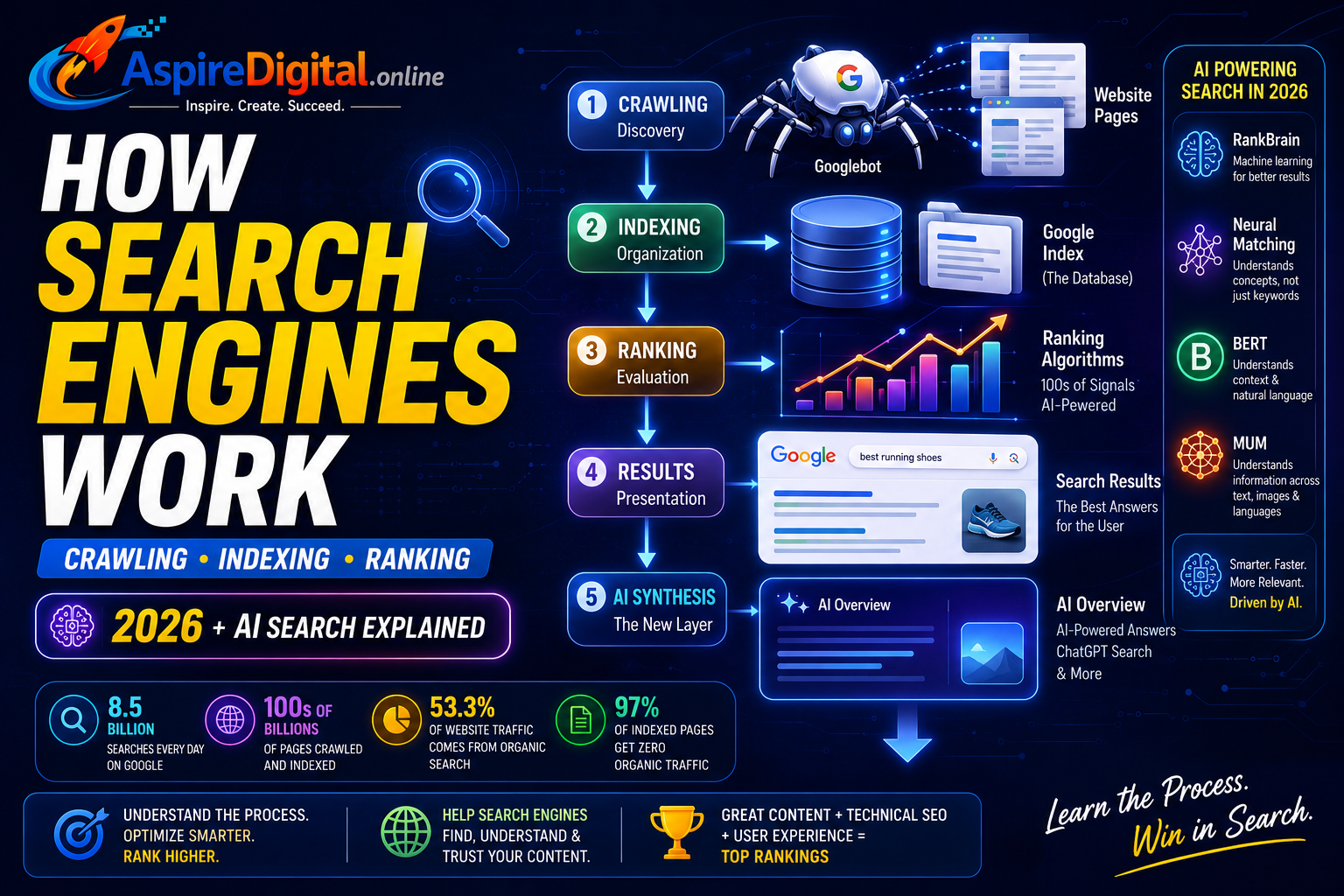
[ADD IMAGE HERE — Suggested alt text: “how search engines work diagram crawling indexing ranking”]
What Are Search Engines and How Do They Work?
Search engines work by using automated bots to discover content across the internet (crawling), analyzing and storing that content in a massive database (indexing), and then evaluating and arranging the most relevant results for a user’s search (ranking).
Think of a search engine like a librarian managing the world’s largest library. First, the librarian has to find every book that exists (crawling). Then, the librarian has to read each book and organize it by topic so it can be found quickly (indexing). Finally, when someone asks a question, the librarian has to know exactly which books will answer it best, and in what order to hand them over (ranking).
This entire process happens continuously, every second of every day, across hundreds of billions of web pages.
Stage 1 — Crawling (Discovery)
Crawling is the very first step in this process — this is where search engines discover that your page even exists.
Search engines use automated programs called crawlers, spiders, or bots (Google’s is called Googlebot) to scan the internet 24/7. These bots move from page to page by following links, reading content, and flagging new or updated URLs for further processing.
How Do Crawlers Find Your Pages?
There are two primary ways:
- Links from pages Google already knows about — if another website links to your page, Googlebot can discover it by following that link.
- XML sitemaps — a file you submit to Google that acts as a curated roadmap of exactly which URLs you want crawled.
If your page has no links pointing to it and is not in your sitemap, search engines may never find it at all — no matter how good your content is.
Stage 2 — Indexing (Organization)
Once a bot discovers a page, it does not automatically get included in search results. The page must first go through indexing.
Indexing is the process where search engines analyze your page’s content, extract meaningful information (text, images, videos, structured data), and store it in a massive, constantly updated database called the index.
During this stage, Google evaluates whether your content is genuinely worth storing. Not every crawled page makes it into the index — Google specifically looks for quality and relevance signals before deciding to index a page.
This is why simply publishing a page does not guarantee it will show up on Google. It has to pass the indexing quality check first.
Stage 3 — Ranking (Evaluation)
Ranking is where the real competition happens. When a user types a search query, the engine does not simply pull up every page that contains those keywords. Instead, it analyzes hundreds of signals to determine which pages best answer that specific query — then arranges them from most to least relevant.
In 2026, ranking is no longer a single, simple algorithm. It is a layered stack of multiple AI-driven systems working together. No single signal dominates ranking anymore. Back in the early 2000s, the number of backlinks pointing to your site was the single biggest ranking factor. In 2026, backlinks are just one signal among dozens.
Stage 4 — How Search Engines Work With AI in 2026
Here is what has fundamentally changed in 2026: search engines now have a fourth layer sitting on top of crawling, indexing, and ranking — an AI synthesis layer.
Google AI Mode now uses something called query fan-out — this means one question you type gets automatically split into multiple smaller sub-queries behind the scenes. The AI then grounds its answer in a curated set of indexed pages and provides explicit citations back to those sources.
Meanwhile, AI-native search tools like Perplexity and ChatGPT Search work differently — they rely on a technique called Retrieval-Augmented Generation (RAG) instead of the traditional indexing systems Google uses.
What does this mean for you? The strategic priority in 2026 is no longer just being rankable — it is being retrievable and citable across both traditional search results and AI-generated summaries. Research shows that the majority of AI citations come from pages that are already ranking in the top 10 of traditional search results — meaning traditional SEO is still the foundation, even for AI visibility. You can read more about this shift directly on Google’s official Search documentation.
How Crawl Budget Works (And Why It Matters)
Search engines do not have unlimited resources to crawl every single page on the internet endlessly. Each website is given a crawl budget — a limited amount of time and resources search engines are willing to spend crawling your site.
This budget is influenced by:
- Your site’s speed — slower sites get crawled less frequently
- Your site’s reliability — frequent downtime hurts your crawl budget
- Your site’s popularity — sites with more authority and traffic get crawled more often
Here is a fact that surprises most beginners: improving your server response time by just 100 milliseconds can increase how much Google crawls your site by 15%. Site speed directly affects whether your content gets discovered in the first place.
[ADD IMAGE HERE — Suggested alt text: “crawl budget optimization chart how search engines work”]
Major Google Ranking Systems You Should Know
| System | What It Does |
|---|---|
| RankBrain | Interprets unclear, ambiguous, or never-seen-before search queries |
| Neural Matching | Connects words to the broader concept and meaning behind a search |
| BERT | Understands language context and nuance in a search query |
| MUM | Understands information across text, images, and multiple languages |
| Query Fan-Out (AI Mode) | Splits one search into multiple sub-queries for deeper, synthesized answers |
How to Help Search Engines Crawl and Index Your Site
Here is a practical, step-by-step approach to make sure search engines can properly find, understand, and rank your content:
Step 1 — Submit an XML sitemap. This gives search engines a direct roadmap of every page you want indexed. RankMath automatically generates this for you.
Step 2 — Build internal links. Link your new pages from existing, already-indexed pages on your site. This helps crawlers discover new content faster.
Step 3 — Improve your site speed. Faster loading times mean a better crawl budget and a better user experience.
Step 4 — Fix broken links and duplicate content. These waste your crawl budget and can hurt your overall site quality signals.
Step 5 — Use a clear, logical site structure. Search engines should be able to understand your website’s hierarchy easily.
Step 6 — Publish original, genuinely useful content. Generic or AI-generated “filler” content is far less likely to get indexed or ranked well.
Common Mistakes That Block Crawling and Indexing
Blocking pages in robots.txt by accident. Many beginners unintentionally block important pages from being crawled at all.
Not submitting a sitemap. Without one, search engines have to rely entirely on discovering links organically — which is much slower.
Publishing thin or duplicate content. Pages with little unique value often get crawled but never indexed.
Ignoring site speed. Slow websites get a smaller crawl budget, meaning fewer of your pages get discovered and updated in the index.
Having orphan pages. Pages with zero internal links pointing to them are extremely hard for crawlers to find.
Expert Tips to Get Your Pages Indexed Faster
Tip 1 — Use Google Search Console’s “Request Indexing” feature. After publishing a new post, manually request indexing through Google Search Console. This often gets your page crawled within hours instead of days.
Tip 2 — Interlink new posts with high-authority existing posts. Crawlers follow links from your strongest, most-visited pages more frequently.
Tip 3 — Keep your sitemap clean. Remove outdated or deleted URLs from your sitemap regularly.
Tip 4 — Focus on demonstrated value, not just keywords. Search engines and AI synthesis layers heavily reward content backed by real expertise and genuine usefulness.
Tip 5 — Monitor your Crawl Stats report in Search Console. This shows you exactly how often Google is crawling your site and flags any crawling errors.
Crawling vs Indexing vs Ranking — Quick Comparison
| Stage | What Happens | Goal |
|---|---|---|
| Crawling | Bots discover your page by following links or sitemaps | Get your page found |
| Indexing | Search engine analyzes and stores your page in its database | Get your page stored and eligible to rank |
| Ranking | Search engine evaluates and arranges results for a query | Get your page shown to the right searchers |
Frequently Asked Questions
How do search engines work in simple terms?
In simple terms, search engines send bots to discover web pages (crawling), store and organize that content in a massive database (indexing), and then evaluate and display the most relevant pages for a user’s search (ranking).
How long does it take for Google to crawl and index a new page?
It can range from a few hours to several weeks, depending on your site’s authority, crawl budget, and whether you manually request indexing through Google Search Console.
Why is my page not showing up on Google even though it’s published?
This usually means your page has either not been crawled yet, was crawled but not indexed due to quality concerns, or is being blocked by your robots.txt file. Check Search Console’s URL Inspection tool to diagnose the issue.
What is crawl budget and why does it matter?
Crawl budget is the limited amount of time and resources a search engine allocates to crawling your website. A larger, faster, more authoritative site gets a bigger crawl budget.
Is ranking still based mainly on backlinks?
No. While backlinks remain important, ranking in 2026 relies on a complex stack of systems including RankBrain, Neural Matching, BERT, and MUM — evaluating hundreds of signals.
How is AI changing how search engines work?
AI has added a new synthesis layer on top of traditional crawling, indexing, and ranking. Tools like Google AI Mode now break a single search into multiple sub-queries and generate synthesized answers with citations.
Does site speed really affect how often my site gets crawled?
Yes. Improving server response time by even 100 milliseconds can increase crawl frequency by around 15%.
Conclusion
Understanding how search engines work — crawling, indexing, ranking, and now the AI synthesis layer — transforms SEO from a mysterious black box into a logical system you can actually optimize.
The fundamentals have not changed: search engines still need to find your content, understand it, and trust it enough to show it to real people. What has changed in 2026 is the added complexity of AI systems that synthesize, summarize, and cite content directly within search results.
The takeaway is simple: build a fast, well-structured website, publish genuinely useful content, and make it as easy as possible for both traditional crawlers and AI systems to discover, understand, and trust your pages.
If you’re just getting started, check out our guide on what digital marketing is to understand the bigger picture before going deeper into SEO. You can also learn more about my background and experience building 30+ websites.
About the Author
Tarun is a Digital Marketing Specialist and WordPress Developer with 3+ years of hands-on experience helping businesses grow online. He has built 30+ real-world websites and delivered digital marketing services across industries including healthcare, hospitality, enterprise services, visa consulting, wellness, and more. Through AspireDigital.online, Tarun shares practical, no-fluff digital marketing strategies to help creators, freelancers, and business owners thrive in the digital world.
🔗 Portfolio | Instagram | LinkedIn | What is Digital Marketing? Complete Beginner’s Best Guide 2026