Last Updated: June 2026 | Author: Tarun | Read Time: 11 min
Table of Contents
- Key Takeaways
- Introduction
- What Are the Types of SEO?
- Type 1 — On-Page SEO
- Type 2 — Off-Page SEO
- Type 3 — Technical SEO
- Type 4 — Local SEO
- How All 4 Types of SEO Work Together
- Types of SEO — Side-by-Side Comparison
- Common Mistakes Beginners Make With SEO Types
- Expert Tips to Apply All 4 Types of SEO
- Frequently Asked Questions
- Conclusion
Key Takeaways
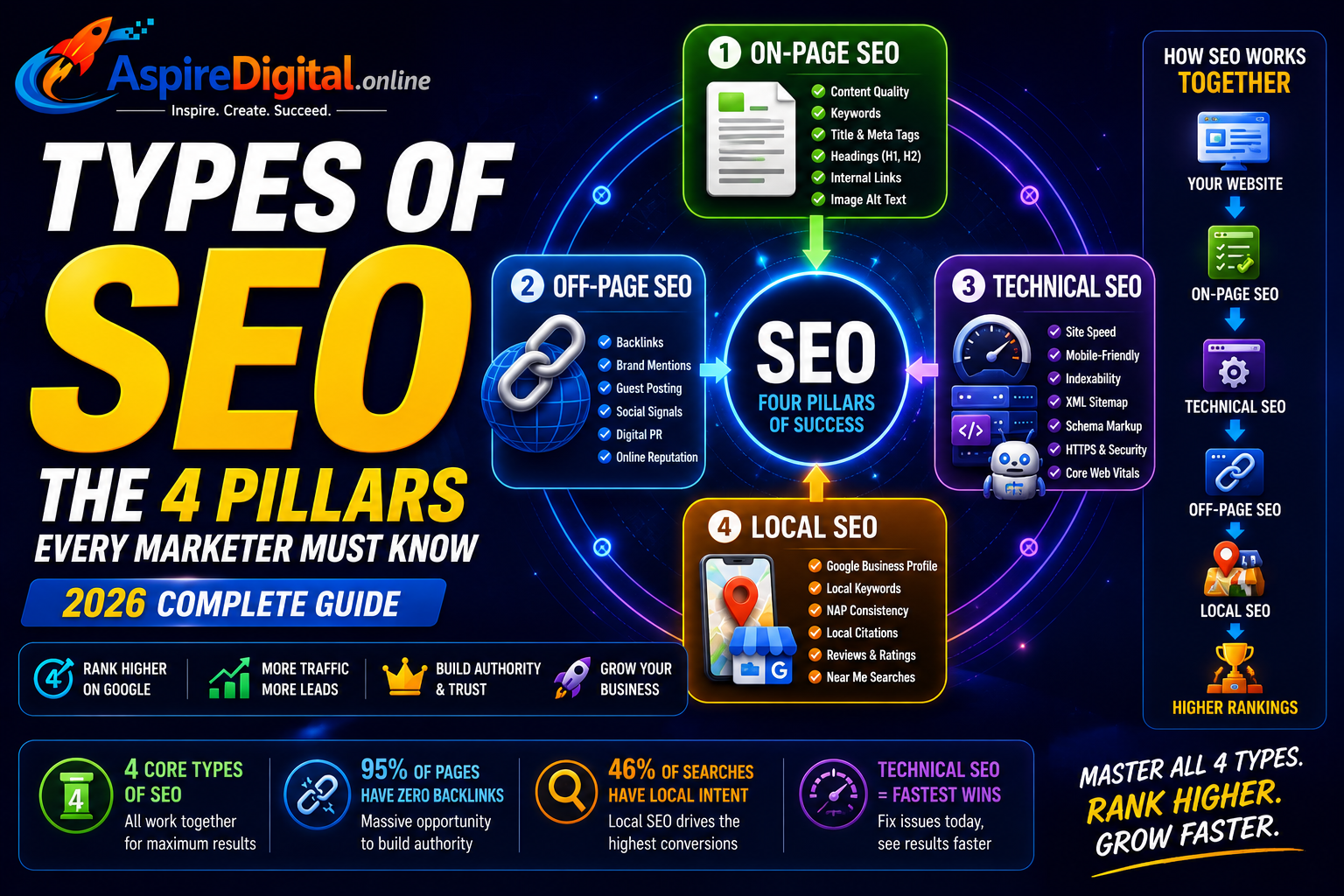
- There are 4 core types of SEO — on-page, off-page, technical, and local — and every successful website uses all four together.
- The global SEO services market is worth $83.98 billion in 2026 and is projected to reach $148.86 billion by 2031.
- Technical SEO is the fastest way to improve rankings — many fixes deliver results almost instantly, unlike content or link building which takes months.
- 46% of all Google searches have local intent — making local SEO one of the highest-conversion strategies for businesses with a physical presence.
- 95% of pages online have zero backlinks — making off-page SEO one of the biggest untapped opportunities for most websites.
Introduction
Most people hear “SEO” and think it is one single thing — stuff some keywords into a page and hope Google notices. But SEO is actually made up of 4 distinct types, each targeting a different layer of how search engines find, evaluate, and rank your website. Miss even one, and your entire strategy has a weak link.
In this guide, we break down all 4 types of SEO with real examples, a comparison table, and expert tips you can apply today. If you are brand new, start with our guide on what digital marketing is and how search engines work first.
[ADD IMAGE HERE — Suggested alt text: “types of SEO on-page off-page technical local explained”]
What Are the Types of SEO?
The 4 main types of SEO are on-page SEO, off-page SEO, technical SEO, and local SEO. Each type focuses on a different aspect of how search engines discover, evaluate, and rank your content. Together, they form a complete SEO strategy.
Think of it like building a house. On-page SEO is the interior design — what is inside your pages. Technical SEO is the foundation and structure. Off-page SEO is your reputation in the neighbourhood — what others say about you. And local SEO is your address and signboard — how nearby customers find you.
Ignore any one of these, and your house either looks great but falls apart from the inside, or is beautifully built but nobody can find it.
Type 1 — On-Page SEO
On-page SEO is the process of optimizing the content and HTML elements on individual web pages so search engines can understand what each page is about and rank it for the right keywords.
This is the type of SEO most people are familiar with — and the one you have the most direct control over, since everything happens on your own website.
What Does On-Page SEO Include?
- Title tags — the clickable headline that appears in search results (should include your focus keyword near the beginning)
- Meta descriptions — the short summary below the title in search results (should include keyword and a compelling reason to click)
- Headings (H1, H2, H3) — the structure of your content, which helps both readers and search engines understand your page hierarchy
- URL structure — short, descriptive URLs that include the target keyword
- Keyword placement — using your focus keyword naturally in the first paragraph, subheadings, and throughout the content
- Internal links — linking to other relevant pages on your site to help users navigate and help crawlers discover more of your content
- Image alt text — describing your images with keyword-relevant text so search engines understand what each image shows
- Content quality — well-written, original, helpful content that actually answers the user’s question better than competing pages
Why On-Page SEO Matters in 2026
On-page SEO directly determines whether Google understands your content well enough to rank it for the right queries. With AI systems now generating summaries and extracting direct answers from your pages, clear structure — proper headings, direct answers, and clean formatting — has become more important than ever.
A well-structured page with strong on-page SEO is also far more likely to appear in Google AI Overviews, featured snippets, and voice search answers than a page that is technically live but poorly formatted.
Type 2 — Off-Page SEO
Off-page SEO refers to all actions taken outside of your own website to improve your rankings — primarily building backlinks, brand mentions, and authority signals that tell search engines your site is credible and trustworthy.
If on-page SEO is you telling Google you are an expert, off-page SEO is everyone else confirming it.
What Does Off-Page SEO Include?
- Link building — earning backlinks from other reputable websites that point to your content (a vote of confidence in your authority)
- Guest posting — writing articles for other websites in your niche that link back to your site
- Brand mentions — when other websites mention your brand name, even without a direct link, these still signal authority
- Social signals — shares, engagement, and discussions about your content across social media platforms
- Digital PR — getting featured in news articles, podcasts, interviews, and industry publications
- Forum and community participation — platforms like Reddit, Quora, and LinkedIn where you contribute expertise and earn visibility
Why Off-Page SEO Matters in 2026
Here is a stat that should wake every website owner up: 95% of pages on the internet have zero backlinks. This means that simply building even a small number of quality links puts you ahead of the vast majority of your competition.
Backlinks remain one of the strongest ranking signals in 2026 — and they are also a key trust signal for AI systems like ChatGPT and Perplexity when deciding which sources to cite. The more your content is referenced by reputable sites, the more likely it is to appear inside AI-generated answers too.
You can learn more about Google’s own guidance on building quality links at Google Search Central’s link best practices guide.
[ADD IMAGE HERE — Suggested alt text: “types of SEO off-page backlink building strategy 2026”]
Type 3 — Technical SEO
Technical SEO is the process of optimizing your website’s infrastructure — speed, crawlability, indexability, security, and structure — so that search engines can efficiently access, understand, and rank your content.
Think of technical SEO as the engine under the hood. Your website could have the best content in the world, but if Googlebot cannot crawl it properly, or if your pages take 8 seconds to load, none of that great content will ever rank.
What Does Technical SEO Include?
- Site speed and Core Web Vitals — how fast your pages load and how smooth the user experience feels
- Mobile-first indexing — since 2023, Google crawls and indexes the mobile version of your site first
- XML sitemap — a file that tells search engines which pages to crawl and index
- Robots.txt — a file that tells crawlers which pages they should and should not crawl
- HTTPS and SSL — a secure website is a ranking signal and a trust signal for users
- Canonical tags — resolves duplicate content issues by telling search engines which version of a page is the “main” one
- Structured data and schema markup — adds additional context to your pages so search engines understand your content at a deeper level
- Internal linking architecture — a logical site structure that makes it easy for crawlers to discover all your pages
Why Technical SEO Matters in 2026
Technical SEO is the fastest way to improve your search performance. Unlike content creation or link building — which can take months to show results — fixing a technical issue can improve your visibility almost immediately.
Research shows that 84% of average websites have at least one Core Web Vitals issue on their first technical audit — and e-commerce sites that fix these report 15–30% conversion rate improvements and 12–20% organic traffic increases. The opportunity here is massive, and most website owners are simply not paying attention to it.
For deeper guidance on technical specifics, Google’s official technical SEO documentation is the most authoritative source available.
Type 4 — Local SEO
Local SEO is the process of optimizing your online presence so your business appears in location-based search results — including Google Maps, the local pack (the 3 business listings shown at the top of local searches), and “near me” queries.
If you run a business that serves customers in a specific area — a clinic, restaurant, salon, digital marketing agency, or any service-based business — local SEO is not optional. It is the primary way local customers find you online.
What Does Local SEO Include?
- Google Business Profile (GBP) — your free listing on Google Maps that shows your name, address, phone number, hours, photos, and reviews
- NAP consistency — your Name, Address, and Phone number must be identical across every online listing and directory
- Local citations — mentions of your business on directories like JustDial, Sulekha, IndiaMart, Google Maps, and industry-specific directories
- Google Reviews — the quantity, quality, and recency of your reviews directly impact local rankings
- Local keywords — targeting location-specific phrases like “digital marketing agency in Hyderabad” or “best SEO consultant near me”
- Location pages — if you serve multiple areas, dedicated pages for each location boost visibility in those specific searches
Why Local SEO Matters in 2026
The numbers here are extraordinary. 46% of all Google searches have local intent — meaning nearly 1 in 2 searches are from people looking for something near them. And 76% of people who search for something nearby visit a business within 24 hours.
For businesses with a physical presence or a local service area, local SEO is the single highest-conversion marketing channel available. A complete Google Business Profile gets 7 times more clicks than an incomplete one — and customers are 2.7 times more likely to consider a business with a fully optimized profile as reputable.
In 2026, local SEO is also being influenced by AI. ChatGPT Search now shows business websites for 58% of its local search results — meaning your GBP and on-site local signals now affect not just Google Maps but also AI-generated local recommendations.
How All 4 Types of SEO Work Together
The 4 types of SEO are interconnected — none works well in isolation. Here is a quick real-world example: you run a dental clinic in Hyderabad. You write a blog on “teeth whitening in Hyderabad” (on-page). Your site loads fast with schema markup (technical). A health directory links to you (off-page). Your Google Business Profile is fully updated (local).
Result? You rank in Google search, appear on Maps, show in AI recommendations, and get found via voice search. That is the compound power of all 4 types working together.
Types of SEO — Side-by-Side Comparison
| Type | Focus Area | Key Activities | Time to See Results | Best For |
|---|---|---|---|---|
| On-Page SEO | Your page content and HTML | Keywords, headings, meta tags, internal links, content quality | 4–12 weeks | All websites |
| Off-Page SEO | External authority signals | Link building, guest posts, brand mentions, digital PR | 3–6 months | All websites |
| Technical SEO | Site infrastructure | Site speed, Core Web Vitals, schema, sitemaps, mobile optimization | Immediate to 4 weeks | All websites |
| Local SEO | Location-based visibility | Google Business Profile, reviews, local citations, NAP consistency | 4–12 weeks | Local and service-area businesses |
Common Mistakes Beginners Make With SEO Types
Focusing only on on-page SEO and ignoring the rest. On-page is a great starting point, but without technical SEO your pages may never get indexed, without off-page SEO your site has no authority, and without local SEO nearby customers cannot find you.
Skipping technical SEO because it seems too complex. You do not need to be a developer. Google Search Console (free) highlights the most critical issues, and most WordPress problems are fixable with simple settings adjustments.
Treating backlinks as the only off-page signal. In 2026, brand mentions, reviews, and social signals also contribute to your authority — especially for appearing in AI-generated search responses.
Setting up Google Business Profile and forgetting about it. Local SEO requires ongoing attention — responding to reviews, adding photos, posting updates, and keeping your information current. Businesses that post regularly see 5x more views according to Google’s data.
Treating all 4 types as separate projects. The most effective strategies work on all four types simultaneously, because improvements in one area amplify results in the others.
Expert Tips to Apply All 4 Types of SEO
Tip 1 — Fix technical issues before anything else. Having built 30+ websites, the most consistent pattern I have seen is this: technical problems hold everything else back. Run a free audit in Google Search Console before writing new content.
Tip 2 — Start on-page SEO with keyword research, not assumptions. Use free tools like Google Keyword Planner or Ubersuggest to find what your audience actually searches for — then write content around those specific phrases.
Tip 3 — Build backlinks through content people want to share. Data-driven guides, original research, and comprehensive how-to articles naturally earn links. Guest posting on relevant sites in your niche also works well.
Tip 4 — Treat your Google Business Profile like a social media account. Post updates weekly, respond to every review, add photos regularly, and keep hours and services accurate. This habit alone can dramatically lift your local pack visibility.
Tip 5 — Optimize for AI search alongside traditional SEO. In 2026, all 4 types of SEO influence your visibility in AI-generated results. Clear content structure, schema markup, quality backlinks, and a strong GBP all feed into how Google AI Mode, ChatGPT Search, and Perplexity surface your business.
Frequently Asked Questions
What are the main types of SEO?
The 4 main types of SEO are on-page SEO (optimizing your page content and HTML), off-page SEO (building external authority through backlinks and brand mentions), technical SEO (optimizing your site’s infrastructure), and local SEO (improving visibility in location-based searches).
Which type of SEO should I focus on first?
Start with technical SEO — fix any crawlability, speed, and indexing issues first, since these affect how effectively every other type of SEO works. Then focus on on-page SEO to ensure your content is well-structured and keyword-optimized. Add off-page and local SEO as your site grows.
Is local SEO only for small businesses?
No. Local SEO is relevant for any business serving customers in a specific area — from small shops to large multi-location enterprises. Even national brands use local SEO to capture high-intent “near me” searches in specific cities.
How are types of SEO different from each other?
Each type addresses a different layer: on-page covers your content, off-page covers your reputation, technical covers your site infrastructure, and local covers geographic visibility. They work best together as part of a unified strategy.
Does technical SEO really matter that much?
Yes. Research shows 84% of websites have at least one Core Web Vitals issue on first audit. Fixing technical problems is often the fastest way to improve rankings — without a solid foundation, great content and strong backlinks consistently underperform.
What is the most important type of SEO in 2026?
All four matter, but technical SEO is the foundation. In 2026, with AI-powered search adding complexity, content quality (on-page) and authority (off-page) are increasingly important for appearing in AI-generated summaries, not just blue links.
Can I do SEO myself or do I need an agency?
You can handle the basics yourself — especially on-page and local SEO. Free tools like Google Search Console, Google Analytics, and RankMath cover most of what you need to start. Technical and off-page SEO may benefit from professional help as your site grows.
Conclusion
SEO is not one thing — it is 4 interconnected pillars that all need attention. On-page, off-page, technical, and local SEO each play a unique role, and the strongest websites in 2026 treat all four as parts of one unified strategy.
SEO still delivers 91% positive ROI for marketers, and the longer you invest in it, the more profitable it becomes. Start with a technical audit, optimize your content, build authority through quality links, and claim your spot in local search — then stay consistent.
Next up, we go deeper into SEO Ranking Factors — the exact signals Google uses to decide where your page appears. Check out our earlier guide on how search engines work if you missed it.
About the Author
Tarun is a Digital Marketing Specialist and WordPress Developer with 3+ years of hands-on experience helping businesses grow online. He has built 30+ real-world websites and delivered digital marketing services across industries including healthcare, hospitality, enterprise services, visa consulting, wellness, and more. Through AspireDigital.online, Tarun shares practical, no-fluff digital marketing strategies to help creators, freelancers, and business owners thrive in the digital world.
🔗 Portfolio | Instagram | LinkedIn