Last Updated: June 2026 | Author: Tarun | Read Time: 11 min
Table of Contents
- Key Takeaways
- Introduction
- What Are SEO Ranking Factors?
- Factor 1 — Content Quality and Helpfulness
- Factor 2 — E-E-A-T Signals
- Factor 3 — Search Intent Match
- Factor 4 — Backlinks and Domain Authority
- Factor 5 — Core Web Vitals and Page Experience
- Factor 6 — Mobile-First Indexing
- Factor 7 — Topical Authority
- Factor 8 — On-Page Optimization
- Factor 9 — User Engagement Signals
- Factor 10 — Generative Engine Optimization (GEO)
- All 10 SEO Ranking Factors — Quick Reference Table
- Common Mistakes That Kill Your Rankings
- Expert Tips to Improve Your SEO Ranking Factors
- Frequently Asked Questions
- Conclusion
Key Takeaways
- Google uses over 200 SEO ranking factors, but 10 core signals drive the vast majority of ranking outcomes in 2026.
- Core Web Vitals now account for roughly 28% of ranking weight — making page experience a direct ranking signal, not just a tiebreaker.
- Pages with strong E-E-A-T signals have a 30% higher chance of appearing in the top 3 search results.
- The number one result on Google has 3.8 times more backlinks than results in positions 2 through 10.
- Fewer than 20% of pages ranking #1 on Google also appear in AI-generated answers — meaning traditional SEO and GEO now require separate but parallel strategies.
Introduction
If you have ever wondered why some pages rank on the first page of Google while others — sometimes with better content — are buried on page five, the answer lies in SEO ranking factors.
Google uses over 200 signals to evaluate every page on the internet. But not all of them carry equal weight. In 2026, the SEO ranking factors that actually move the needle have shifted significantly — AI-powered systems now interpret content far more deeply than simple keyword matching, and a new layer of generative search has added entirely new visibility channels beyond traditional blue links.
In this guide, we break down the 10 most important SEO ranking factors Google uses right now — with real data, clear explanations, and actionable steps for each one. For context on how these signals are applied, check out our earlier guides on what digital marketing is and the 4 types of SEO.
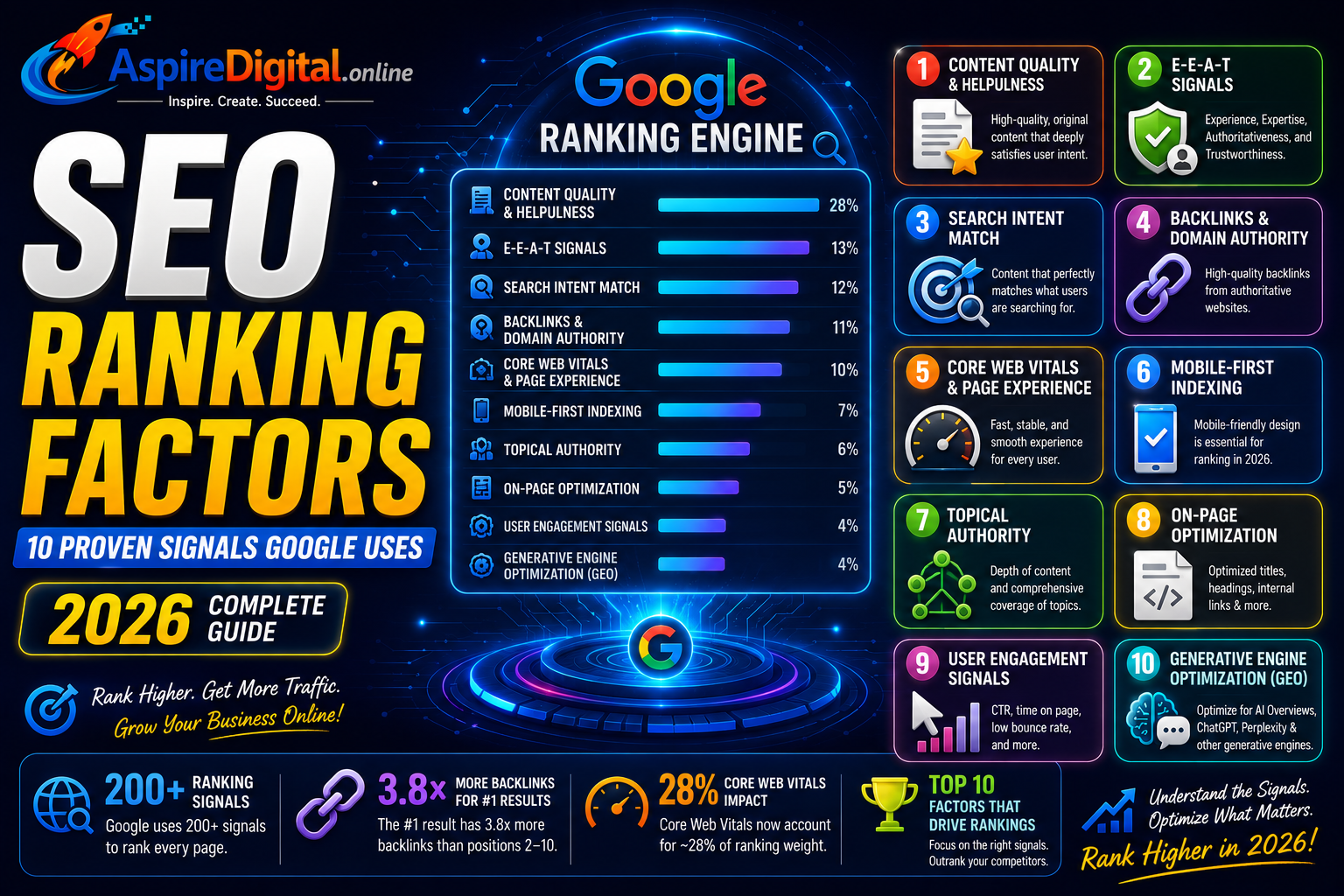
[ADD IMAGE HERE — Suggested alt text: “SEO ranking factors Google uses in 2026 infographic”]
What Are SEO Ranking Factors?
SEO ranking factors are the signals Google uses to evaluate and determine where a web page appears in search results. They include content quality, backlinks, page experience, technical health, and user behaviour — and they work together as a layered system, not a flat checklist.
Think of Google’s ranking system as a staged evaluation. First, it retrieves a pool of potentially relevant pages using basic signals like keywords and PageRank. Then, deeper AI models — including BERT, MUM, and RankBrain — re-rank those pages based on quality, authority, freshness, and experience. Finally, spam detection and quality filters make final adjustments before results are shown.
The important thing to understand is that no single SEO ranking factor guarantees top rankings. Google evaluates the combined strength of all signals together. A page with exceptional content but weak authority will not rank. A highly authoritative domain will not save thin or outdated content. The strongest pages in 2026 are the ones where multiple factors reinforce each other simultaneously.
Factor 1 — Content Quality and Helpfulness
Content quality is the single most important SEO ranking factor in 2026. Google’s Helpful Content system specifically rewards pages that provide genuine value, original insight, and accurate information — and actively suppresses pages that are generic, repetitive, or AI-generated without real human editing.
What makes content “high quality” in Google’s eyes has become much more specific. Helpful content must directly satisfy the searcher’s intent, cover the topic comprehensively, and offer something that cannot be found on every other website covering the same topic.
Pages with thin content, keyword stuffing, or AI-generated fluff without human oversight lost significant visibility in recent Google updates. Meanwhile, pages that demonstrate firsthand knowledge, original data, and clear practical value have consistently strengthened their rankings.
What to do: Write content that answers the searcher’s question completely and better than your competitors. Include original examples, real data, and practical steps. Edit AI-assisted drafts with your own expertise and experience before publishing.
Factor 2 — E-E-A-T Signals
E-E-A-T stands for Experience, Expertise, Authoritativeness, and Trustworthiness. It is Google’s quality evaluation framework — and in 2026, it is more critical than ever. Pages with strong E-E-A-T signals are 30% more likely to appear in the top 3 search results.
Here is what each element means in practice:
- Experience — Does the author have firsthand, real-world experience with the topic? (This is the newest addition — added in 2022 and now heavily weighted)
- Expertise — Does the content demonstrate deep, accurate knowledge of the subject?
- Authoritativeness — Is the author and website recognized as a credible source in the niche?
- Trustworthiness — Is the page honest, accurate, safe, and reliable?
E-E-A-T is not a direct ranking signal itself — Google does not have an “E-E-A-T score.” Instead, it is a framework reflected through multiple signals: your author bio, backlinks from authoritative sources, accurate content, positive brand mentions, and real user trust signals like reviews and engagement.
What to do: Add a detailed author bio with real credentials to every post. Link to authoritative external sources. Show your experience through case studies and real-world examples. Build a strong About page that demonstrates who you are and why you should be trusted.
Factor 3 — Search Intent Match
Search intent is the reason behind a user’s query — and matching it perfectly is one of the most powerful SEO ranking factors in 2026. Google no longer ranks pages based on keyword matching alone. It evaluates whether your page actually delivers what the searcher was looking for.
There are four types of search intent:
- Informational — the user wants to learn something (“what is SEO”)
- Navigational — the user wants to find a specific website (“RankMath login”)
- Commercial — the user is researching before buying (“best SEO tools 2026”)
- Transactional — the user is ready to buy or act (“buy SEMrush subscription”)
If your page targets an informational query but reads like a sales page, Google will not rank it — regardless of how many keywords it contains. The format, depth, and tone of your content must match what searchers at that stage actually expect.
What to do: Before writing any page, search your target keyword in Google and study the top 5 results. Notice what format they use (list, guide, video, comparison), how long they are, and what angle they take. Match that intent — then aim to cover the topic more thoroughly.
Factor 4 — Backlinks and Domain Authority
Backlinks remain one of the strongest SEO ranking factors in 2026. The number one result on Google has 3.8 times more backlinks than results in positions 2 through 10. Quality, relevance, and topical match now matter far more than raw backlink count.
The May 2024 Google Content Warehouse API leak confirmed the existence of siteAuthority — Google’s internal site-wide link popularity score — operating as a modernized PageRank applied at the domain level. This confirmed what SEOs had long suspected: Google evaluates both the authority of individual pages and the overall authority of the entire domain.
In 2026, the most valuable backlinks come from sites that are topically relevant to your niche, have genuine organic traffic, and link to you in a natural editorial context — not paid placements or low-quality directories.
What to do: Focus on earning backlinks through genuinely useful content — data-driven guides, original research, and comprehensive how-to posts naturally attract links. Guest posting on relevant sites in your industry is also a proven and Google-approved strategy. You can review Google’s own guidance at Google Search Central’s link best practices.
Factor 5 — Core Web Vitals and Page Experience
Core Web Vitals are Google’s user experience metrics — and they now account for roughly 28% of ranking weight, making page experience a direct ranking factor, not just a tiebreaker. Sites that fix Core Web Vitals issues report 12–20% organic traffic increases on average.
The three Core Web Vitals metrics in 2026 are:
- LCP (Largest Contentful Paint) — how quickly the main content of your page loads. Target: under 2.5 seconds.
- INP (Interaction to Next Paint) — how quickly your page responds to user interactions like clicks and taps. Target: under 200ms. (INP replaced FID in March 2024)
- CLS (Cumulative Layout Shift) — how stable your page layout is while loading (elements shifting around as the page loads). Target: under 0.1.
These metrics are measured using real Chrome user data — not just lab tests. This means your actual visitors’ experiences on real devices directly influence your ranking.
What to do: Run your site through Google PageSpeed Insights to get your Core Web Vitals scores and a specific list of fixes. For WordPress sites, using a fast theme, optimizing images, and enabling caching can resolve most issues.
[ADD IMAGE HERE — Suggested alt text: “SEO ranking factors core web vitals LCP INP CLS scores 2026”]
Factor 6 — Mobile-First Indexing
Since 2023, Google crawls and indexes the mobile version of your website first. If your mobile experience is broken, slow, or missing content that appears on desktop, your rankings suffer — regardless of how good your desktop site looks.
Mobile-first indexing means the content Google sees on your mobile site is what determines your rankings. Content, images, or structured data present only on desktop are effectively ignored for ranking purposes.
What to do: Test your site on multiple mobile devices. Use Google Search Console’s Mobile Usability report to find issues. Ensure your theme is fully responsive, fonts are readable without zooming, and buttons are easy to tap.
Factor 7 — Topical Authority
Topical authority is one of the fastest-growing SEO ranking factors in 2026. Google increasingly favours websites that demonstrate deep, comprehensive expertise in a specific subject area — rather than publishing scattered content across unrelated topics.
The 2024 Google leak confirmed the existence of siteFocusScore and siteRadius — internal metrics that measure how focused and topically concentrated a website’s content is. A site that covers 50 closely related topics in depth consistently outranks a site that covers 500 random topics superficially.
This is why the strategy behind AspireDigital is built on topic clusters — covering every sub-topic within a niche thoroughly, linked together internally, before expanding to the next niche. This is how websites build genuine topical authority that compounds over time.
What to do: Map out every sub-topic within your niche and create dedicated content for each one. Link related posts together with internal links. Build your content library systematically — cover a topic completely before moving to the next one.
Factor 8 — On-Page Optimization
On-page signals remain a foundational SEO ranking factor — but in 2026, semantic context and entity coverage matter as much as keyword placement. URLs that include the target keyword generate 45% more clicks than those without it.
Key on-page signals: title tag (keyword near start), meta description, H1/H2 headings, URL slug, image alt text, and internal linking. Beyond basics, Google’s BERT and MUM models evaluate semantic richness — meaning you should surround your primary keyword with related terms and entity mentions rather than repeating the exact keyword.
What to do: Use your focus keyword in the title, first paragraph, at least two H2 headings, the URL, and image alt text. Then enrich with semantically related terms. For “email marketing,” entity terms include: open rate, subject line, automation, Mailchimp, list segmentation, A/B testing.
Factor 9 — User Engagement Signals
User engagement signals — including click-through rate, dwell time, scroll depth, and repeat visits — are confirmed SEO ranking factors in 2026. The 2024 Google leak revealed “navBoost,” an internal system that re-ranks pages based on “goodClicks” and “badClicks” from real user interactions.
This means Google is watching what happens after someone clicks your result. If users click your result, spend several minutes reading, and do not immediately return to Google to find a better answer — that is a strong positive signal. If they click your result and bounce back to the search results within seconds — that is a negative signal that can suppress your rankings over time.
Google also confirmed the use of chromeInTotal — aggregated Chrome browser data covering site-visit frequency, on-site experience, and direct traffic. This is a signal Google publicly denied using for years, until the 2024 leak revealed it directly.
What to do: Write compelling title tags and meta descriptions that attract qualified clicks. Structure your content so readers are immediately engaged from the first paragraph. Use headers, tables, bullet points, and images to improve readability and encourage scrolling. Reduce bounce rate by answering the searcher’s question quickly and then guiding them to related content on your site.
Factor 10 — Generative Engine Optimization (GEO)
GEO is the newest and fastest-growing SEO ranking factor dimension in 2026. Research shows that fewer than 20% of pages ranking #1 on Google also appear in AI-generated answers — meaning ranking in traditional search and being cited by AI systems now require separate but parallel optimization strategies.
AI search visitors convert at 14.2% versus traditional organic search’s 2.8% — a 5x quality premium per click. This makes GEO not just a visibility play but a revenue play. Getting cited by ChatGPT, Perplexity, or Google AI Overviews brings significantly higher-intent visitors than traditional clicks.
The key GEO signals are: strong data-backed introductions (AI systems prioritize the first 30% of content for citations), clear structured answers, entity-based writing, credible external citations within your content, and strong E-E-A-T signals that make AI systems trust your source.
What to do: Pack your introduction with verifiable stats and clear direct answers. Use real entity mentions (tools, brands, people, studies). Link to authoritative external sources. Make sure your author bio is detailed and credible. Structure every section so it can stand alone as a clear, citable answer.
All 10 SEO Ranking Factors — Quick Reference Table
| Factor | What It Measures | Impact Level | Quick Win |
|---|---|---|---|
| Content Quality | Helpfulness, originality, depth | 🔴 Very High | Add original data and real examples |
| E-E-A-T | Experience, expertise, authority, trust | 🔴 Very High | Add detailed author bio to every post |
| Search Intent Match | Format and depth alignment with query | 🔴 Very High | Study top 5 results before writing |
| Backlinks | Quality and topical relevance of links | 🔴 Very High | Guest post on niche-relevant sites |
| Core Web Vitals | LCP, INP, CLS scores | 🟠 High | Run PageSpeed Insights and fix top issues |
| Mobile-First Indexing | Mobile UX and content parity | 🟠 High | Test on mobile and fix usability issues |
| Topical Authority | Depth and focus of content coverage | 🟠 High | Build topic clusters systematically |
| On-Page Optimization | Title, headings, URL, semantic terms | 🟡 Medium-High | Keyword in title, H2s, URL, alt text |
| User Engagement | CTR, dwell time, scroll depth | 🟡 Medium-High | Improve title tags and first paragraph |
| GEO | AI citation signals | 🟠 High (growing) | Data-rich intro + clear structured answers |
Common Mistakes That Kill Your Rankings
Chasing the “200 factors” myth. Google’s ranking system is not a flat checklist. Focus on the 10 core pillars above rather than obsessing over minor signals.
Keyword stuffing instead of semantic enrichment. Repeating your keyword 20 times hurts rankings. Google rewards pages that use semantically rich, naturally flowing language around the main topic.
Ignoring mobile experience. With mobile-first indexing fully in effect, a desktop-only mindset is a ranking liability. Every page must be tested on mobile first.
Publishing AI content without editing. Generic AI content without real human expertise consistently loses rankings in Google’s Helpful Content evaluations. AI assists — it does not replace genuine expertise.
Treating GEO as optional. AI search visitors convert at 5x the rate of traditional organic visitors. Ignoring GEO in 2026 means leaving your highest-value traffic channel completely untapped.
Expert Tips to Improve Your SEO Ranking Factors
Tip 1 — Audit your existing content before creating new content. From building and optimizing 30+ websites, one pattern is consistent: most sites have existing pages that could rank much higher with simple updates — fixing intent match, adding E-E-A-T signals, and improving on-page optimization. Audit before you create.
Tip 2 — Prioritize Core Web Vitals on mobile. Run your site through Google PageSpeed Insights on the mobile setting specifically. Most WordPress sites fail on mobile LCP due to unoptimized hero images and render-blocking scripts. Fixing these two issues alone can produce significant ranking improvements.
Tip 3 — Build topical authority before chasing backlinks. A site with 20 deeply interlinked, comprehensive posts on one topic will consistently outrank a site with 200 thin posts and many backlinks. Build the authority of your content cluster first — links will follow naturally.
Tip 4 — Optimize every post for both Google and AI simultaneously. Structure your content with a strong data-backed intro (GEO), clear headings with direct answers (AEO), proper on-page signals (SEO), and a credible author bio (E-E-A-T). These are not separate tasks — they are the same well-structured post.
Tip 5 — Watch your engagement signals actively. Use Google Search Console to monitor your click-through rate for each post. If a post ranks in position 4–8 but has a low CTR, rewrite the title and meta description to be more compelling. A higher CTR alone can lift you to position 1–3 over time.
Frequently Asked Questions
What are the most important SEO ranking factors in 2026?
The most important SEO ranking factors in 2026 are content quality, E-E-A-T signals, search intent match, backlinks, Core Web Vitals, mobile-first indexing, topical authority, on-page optimization, user engagement signals, and GEO (Generative Engine Optimization). These 10 factors drive the vast majority of ranking outcomes.
How many ranking factors does Google use?
Google uses over 200 ranking factors, but they work as a layered system — not a flat checklist. A small set of core factors (content quality, E-E-A-T, backlinks, page experience, and intent match) drive the majority of ranking outcomes. Focusing on these high-impact factors delivers better results than trying to optimize for every minor signal.
Are backlinks still important SEO ranking factors in 2026?
Yes. Backlinks remain one of the strongest SEO ranking factors in 2026. The number one Google result has 3.8 times more backlinks than results in positions 2–10. However, quality and topical relevance now matter far more than raw backlink count.
What is E-E-A-T and why does it matter for SEO?
E-E-A-T stands for Experience, Expertise, Authoritativeness, and Trustworthiness. It is Google’s quality evaluation framework. Pages with strong E-E-A-T signals are 30% more likely to appear in the top 3 results. It is demonstrated through author credentials, accurate content, authoritative backlinks, and real-world experience signals.
Do Core Web Vitals directly affect Google rankings?
Yes. Core Web Vitals — LCP, INP, and CLS — now account for roughly 28% of ranking weight, making them a direct ranking factor. Sites that resolve Core Web Vitals issues typically see 12–20% increases in organic traffic. You can check your scores for free at Google PageSpeed Insights.
What is GEO and how is it different from SEO?
GEO (Generative Engine Optimization) is the practice of structuring content so AI systems like ChatGPT, Perplexity, and Google AI Overviews cite it in their generated answers. SEO focuses on ranking in traditional Google blue links. Research shows fewer than 20% of pages ranking #1 on Google also appear in AI answers — making GEO a separate but parallel strategy.
How long does it take for SEO ranking factors to show results?
It depends on the factor. Technical SEO fixes can show results within days to weeks. On-page optimization typically takes 4–12 weeks. Content quality and topical authority improvements take 3–6 months to fully compound. Backlink building shows results over 3–12 months. GEO signals can produce AI citation visibility faster — often within weeks of publishing well-structured content.
Conclusion
SEO ranking factors in 2026 are no longer a simple checklist — they are a layered, AI-driven evaluation system that rewards genuine expertise, real helpfulness, technical excellence, and authority built over time.
The 10 factors covered in this guide — content quality, E-E-A-T, intent match, backlinks, Core Web Vitals, mobile-first, topical authority, on-page optimization, user engagement, and GEO — are the signals that separate pages that rank from pages that do not, regardless of niche or competition level.
The most important takeaway: no single factor wins alone. Google evaluates the combined strength of all signals together. Build content that is genuinely helpful, demonstrates real expertise, loads fast on mobile, and is structured for both humans and AI systems — and your rankings will compound over time.
Next up on AspireDigital, we go deeper into E-E-A-T — what it really means, how Google evaluates it, and exactly what you can do to strengthen it on your site. Check out our guide on the 4 types of SEO if you missed it.
About the Author
Tarun is a Digital Marketing Specialist and WordPress Developer with 3+ years of hands-on experience helping businesses grow online. He has built 30+ real-world websites and delivered digital marketing services across industries including healthcare, hospitality, enterprise services, visa consulting, wellness, and more. Through AspireDigital.online, Tarun shares practical, no-fluff digital marketing strategies to help creators, freelancers, and business owners thrive in the digital world.
🔗 Portfolio | Instagram | LinkedIn