Last Updated: June 2026 | Author: Tarun | Read Time: 14 min
Table of Contents
- Key Takeaways
- Introduction
- What is White Hat SEO?
- White Hat vs Black Hat vs Grey Hat SEO
- Why White Hat SEO Always Wins in the Long Run
- Strategy 1 — Keyword Research Built Around Search Intent
- Strategy 2 — Helpful, Original, Experience-Driven Content
- Strategy 3 — On-Page SEO Optimization Done Right
- Strategy 4 — Technical SEO — The Foundation Under Everything
- Strategy 5 — Ethical Link Building That Actually Lasts
- Strategy 6 — E-E-A-T and Author Authority Signals
- Strategy 7 — Topical Authority Through Content Clusters
- Strategy 8 — User Experience and Engagement Optimization
- Strategy 9 — AI and Generative Search Optimization (GEO)
- White Hat vs Black Hat — Full Comparison Table
- Common White Hat SEO Mistakes to Avoid
- Expert Tips from Building 30+ Websites
- Frequently Asked Questions
- Conclusion
Key Takeaways
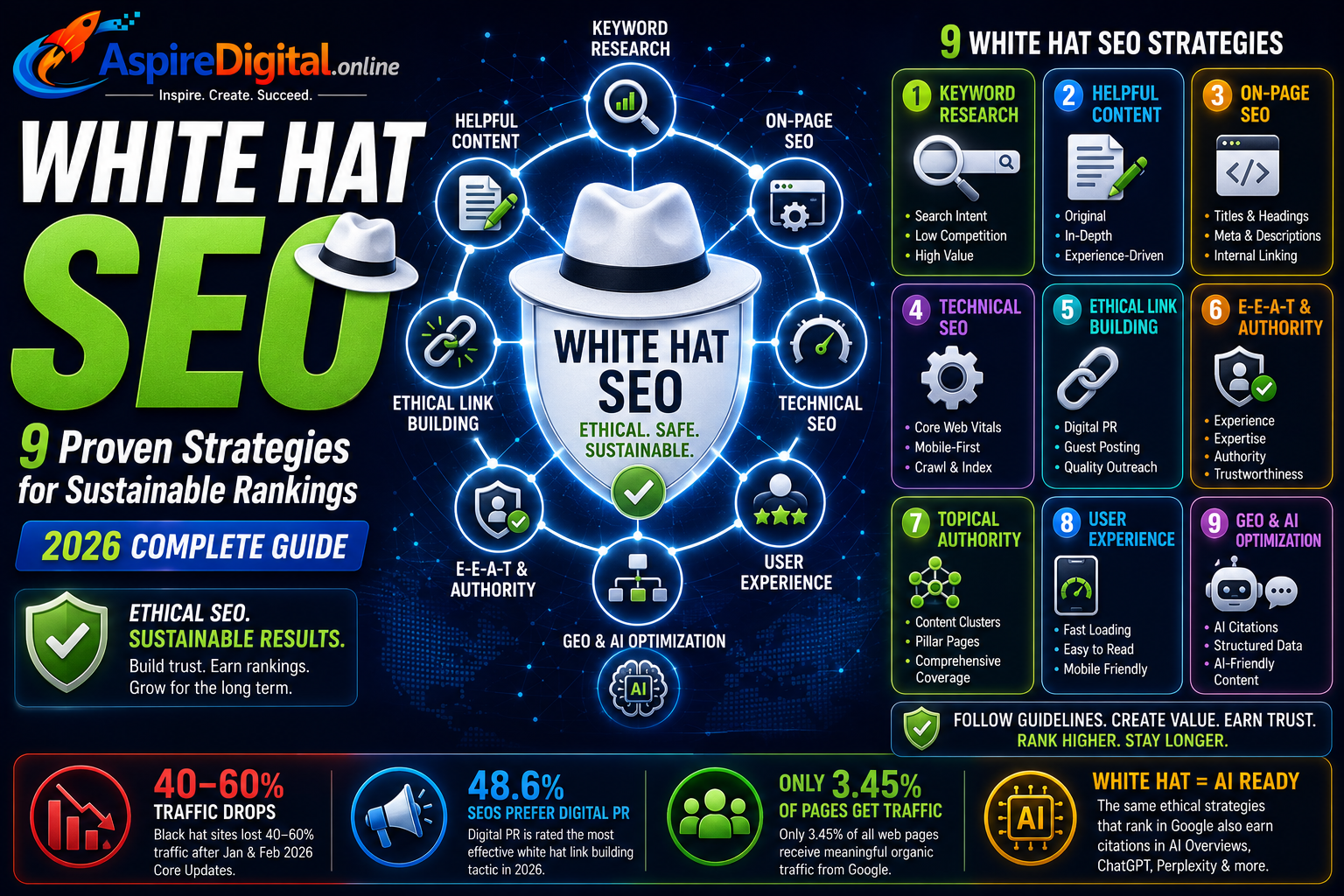
- White hat SEO is the only strategy that compounds over time — sites penalized by Google’s January and February 2026 Core Updates saw 40–60% traffic drops overnight, while white hat sites maintained or grew their positions.
- Digital PR has emerged as the most effective white hat link building tactic in 2026, with 48.6% of SEO professionals rating it their top off-page strategy.
- Only 3.45% of all web pages receive meaningful organic search traffic from Google — white hat SEO is the proven path to joining that group and staying there.
- The Princeton/Georgia Tech GEO study (KDD 2024, 10,000 queries) confirmed that the techniques boosting AI citation visibility are identical to the techniques defining SEO excellence.
- White hat SEO and GEO are now convergent — the same ethical, user-first strategies that rank in Google also determine citation in ChatGPT, Perplexity, and Google AI Overviews.
Introduction
Every few months, another “SEO expert” goes viral claiming to have found a shortcut — a trick that beats Google’s algorithm, a loophole that delivers first-page rankings in days, a grey-area tactic that seems to work until suddenly it does not.
And then Google updates its algorithm. Rankings collapse. Traffic disappears overnight. The shortcut hunters start over from zero.
Meanwhile, the sites built on ethical SEO — the ones that followed Google’s guidelines, created genuinely useful content, earned real backlinks, and built actual authority — survive every update, compound their rankings over time, and grow stronger the longer they persist.
Google’s January 2026 core update reshaped search ranking factors more dramatically than anything since the Helpful Content system launched. Sites relying on paid link schemes saw traffic drops of 40–60% overnight, while brands with organic outreach programmes and genuine content partnerships maintained their positions — or climbed higher as competitors fell away.
This is what white hat SEO delivers — not just compliance, but a compounding competitive advantage that shortcut tactics can never match. In this guide, you will learn exactly what white hat SEO is, how it compares to black hat and grey hat approaches, and the 9 proven strategies that build rankings strong enough to survive anything Google throws at them. This guide builds directly on our earlier coverage of SEO ranking factors and how AI is changing SEO — reading both first will give you the full context.
What is White Hat SEO?
White hat SEO is the practice of improving a website’s search engine rankings using ethical, Google-compliant strategies that prioritize genuine user value, content quality, and long-term sustainable growth — over short-term manipulation or algorithm exploitation.
The term originated in the early 2000s as a direct contrast to “black hat” SEO — a reference to old Western movies where heroes wore white hats and villains wore black. In practice, it simply means: play by the rules. Optimize for the human being using the search engine, not for the algorithm itself. Build something that deserves to rank, rather than trying to trick search engines into thinking it does.
In 2026, the definition has expanded to encompass visibility across both traditional search engines and AI-powered answer engines. White hat SEO and GEO (Generative Engine Optimization) are not separate disciplines — they are convergent. The techniques that boost AI citation visibility are the same techniques that define SEO excellence.
Think of it this way: Black hat SEO is gambling. White hat SEO is compound interest. One might get you rich quick — and poor even quicker — but the other builds a foundation that pays dividends for years.
White Hat vs Black Hat vs Grey Hat SEO
Before diving into strategies, it is important to clearly understand the three categories — because the boundaries between them have shifted significantly in 2026.
White Hat SEO follows all search engine guidelines. It includes helpful content, earned backlinks, clean site structure, proper technical optimization, and genuine user value. It is safe long-term, builds compounding authority, and survives algorithm updates.
Black Hat SEO deliberately violates search engine guidelines to manipulate rankings. Classic examples include keyword stuffing, buying links in bulk, cloaking (showing different content to search bots vs. real users), private blog networks (PBNs), doorway pages, and mass-producing AI-generated spam content without human editing. These tactics may work briefly, but they fail — Google’s guidelines evolve, and what is tolerated today may be penalized tomorrow.
Grey Hat SEO sits between white and black — tactics not explicitly banned but carrying real risk of future penalty. Grey hat SEO combines elements of both. It uses riskier methods that are not explicitly prohibited, but still carry potential penalties. These tactics can sometimes provide short-term benefits, but search engines may penalize them over time. Examples include aggressive link exchanges, spinning AI content at scale, and niche edits on low-quality sites.
The boundaries between white hat, black hat, and grey hat SEO have been redrawn by AI — both Google’s use of AI in ranking and the emergence of AI-generated content. Understanding where these lines now fall is critical for sustainable SEO strategy.
Why White Hat SEO Always Wins in the Long Run
There is a practical reason ethical SEO wins beyond just ethics — and it comes down to compounding.
White hat SEO builds assets that accumulate over time: domain authority, topical expertise, a genuine backlink profile, real user trust, and a growing content library that each reinforce each other. The longer you invest in white hat strategies, the harder your position becomes to displace — because the competitive moat you build is made of things that cannot be manufactured quickly.
Black hat SEO, by contrast, builds nothing that lasts. It exploits loopholes that close. It creates a site profile that becomes increasingly risky the larger it grows. And when Google’s algorithm catches up — which it always does — the entire investment evaporates instantly, often with a manual penalty that takes months or years to recover from.
The biggest new change in white hat SEO for 2026 is the rise of AI-powered search as a real source of traffic, along with the merging of traditional SEO best practices and AI citation optimization. Old-school tricks like buying links do not work for AI-driven SEO. AI models are trained to cite brands that have real social proof. White hat tactics ensure you are building a reputation that earns genuine citations — which is the currency of the future.
Strategy 1 — Keyword Research Built Around Search Intent
Effective white hat SEO starts with keyword research that goes beyond search volume — it matches every piece of content to the real intention behind the query. Targeting the wrong keywords or chasing vanity metrics like traffic volume alone guarantees content that gets impressions but fails to generate actual leads, sales, or results.
In 2026, keyword research means understanding the four types of search intent — informational (someone wants to learn), navigational (someone wants to find a specific site), commercial (someone is researching before buying), and transactional (someone is ready to act) — and matching every piece of content to exactly the right stage of that journey.
High-intent keywords indicate readiness to take action, so targeting commercial investigation and transactional intent keywords generates the best conversion results. But informational keywords build the topical authority and audience trust that make those conversions possible over time.
How to apply this: Use Google Keyword Planner, Google Autocomplete, and Google Trends (all free) to find keywords your actual audience uses. For each keyword you target, search it yourself and study the top 5 results — this shows you exactly what Google believes the correct intent behind that query is, and what format and depth of content will satisfy it.
Strategy 2 — Helpful, Original, Experience-Driven Content
Content quality is the central pillar of white hat SEO in 2026. Google’s Helpful Content system rewards pages that provide genuine value, original insight, and firsthand experience — and actively suppresses generic, recycled, or AI-generated content that adds nothing new to what already exists.
Google’s guidance on E-E-A-T is clear: it rewards content that demonstrates real expertise and genuine helpfulness, regardless of how it was produced. Mass-generated AI content that adds nothing new is still thin content. Where AI works well: drafting outlines, speeding up research, generating first drafts that humans refine. Where it falls short: replacing the subject-matter knowledge and unique perspective that makes content actually worth reading.
Research shows that 94% of people share content because they believe it will be genuinely helpful to others — not because it ranks well. This tells us something fundamental: the content that earns organic amplification, natural backlinks, and social shares is the content that truly solves real problems for real people.
How to apply this: Every piece of content you publish should include something that exists nowhere else — an original case study, a real data point from your own experience, an honest assessment of what actually works versus what just sounds good in theory. For AspireDigital, this means drawing on real client work and real website builds in every guide.
Strategy 3 — On-Page SEO Optimization Done Right
On-page SEO done the white hat way means optimizing every element of your page for both human readers and search engine understanding — without keyword stuffing, manipulative hidden text, or over-optimization that signals gaming rather than genuine relevance.
Header hierarchy signals content structure to search engines. Use exactly one H1 per page containing the primary keyword naturally. H2s for major sections with keyword variations. H3s for subtopics under each H2. Structure headings as questions that mirror “People Also Ask” queries where appropriate.
Internal linking distributes authority and helps crawlers navigate your site. Add 5–10 internal links per 2,000 words using descriptive, keyword-rich anchor text. Link strategically from high-authority pages to pages needing ranking boosts, and update older posts with links to new content.
Although Google rewrites descriptions approximately 63% of the time, custom meta descriptions can increase CTR by 5.8% when they appear. Write in active voice with clear calls-to-action.
How to apply this: Use RankMath to verify every on-page element before publishing. Focus keyword in title (near the start), first paragraph, at least two H2 headings, URL, and image alt text. Then enrich with semantically related terms — not repetitions of the exact keyword.
Strategy 4 — Technical SEO — The Foundation Under Everything
Technical SEO is the white hat foundation that determines whether all your other efforts actually reach the people they are designed for. A beautifully written, perfectly optimized post that loads in 8 seconds on mobile, has broken internal links, and is not properly indexed will never rank — regardless of its content quality.
Only 47–54% of websites currently meet all Core Web Vitals thresholds. Those improving from “Poor” to “Good” report 25% conversion rate increases. This is one of the highest-leverage, lowest-effort improvements available to most websites — because the majority of competitors are simply not paying attention to it.
Core technical white hat priorities in 2026 include: HTTPS security, XML sitemap submission, clean robots.txt configuration, mobile-first optimization (Google completed its transition to 100% mobile-first indexing in July 2024), Core Web Vitals (LCP under 2.5s, INP under 200ms, CLS under 0.1), schema markup implementation, and clean internal linking architecture.
How to apply this: Run your site through Google PageSpeed Insights and Google Search Console’s Core Web Vitals report monthly. Fix the issues flagged there before worrying about content volume. A fast, clean, properly indexed site is worth more than 100 blog posts on a slow, broken one.
Strategy 5 — Ethical Link Building That Actually Lasts
Backlinks remain one of the most powerful white hat SEO signals in 2026 — but the definition of “good links” has narrowed considerably. Quality, topical relevance, and editorial authenticity now matter far more than quantity. A single high-authority, topically relevant editorial link outperforms hundreds of directory submissions or purchased placements.
Digital PR emerged as the most effective white hat tactic, with 48.6% of SEO professionals rating it top in 2025. Creating newsworthy data studies, industry surveys, and expert commentary that journalists and publications want to reference builds the kind of high-authority editorial link profile that Google’s algorithm rewards most strongly.
Broken link building maintains a 17% average success rate while remaining completely guideline-compliant. Each earned link carries exponentially more weight than hundreds of low-quality alternatives.
Guest posting on relevant, authoritative sites remains a fully legitimate and effective white hat approach — when executed with genuine content quality and strict niche relevance. The key distinction: writing genuinely useful articles for respected publications in your space, versus publishing thin posts on low-quality link farms purely to place a link.
Cold outreach maintains just an 8% success rate, but the links you do earn carry exponentially more weight. Domain authority built through content partnerships and genuine brand authority creates ranking stability that survives algorithm shifts.
How to apply this: Focus link building efforts on three channels: creating genuinely link-worthy content (original data, comprehensive guides, tools), guest posting on relevant industry sites with real editorial standards, and digital PR through data-driven stories and expert commentary.
Strategy 6 — E-E-A-T and Author Authority Signals
Building E-E-A-T signals is not just an ethical choice — it is the most reliable SEO investment you can make in 2026. Sites with clear author credentials, publication history, and third-party verification now see measurably better rankings across every major Google update.
Every blog post needs a real, credentialed, identifiable author with a detailed bio. Every factual claim needs a cited source. Every page needs to come from a site with a complete, transparent About page, a Contact page, a Privacy Policy, and HTTPS security. These are not optional compliance checkboxes — they are the trust infrastructure that determines how much weight every other SEO signal carries.
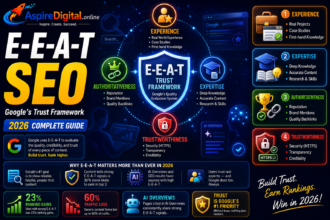
For deeper guidance on exactly how to build E-E-A-T signals effectively, our complete guide to E-E-A-T SEO covers every component in detail. It pairs directly with this guide as the essential companion to white hat SEO strategy.
How to apply this: Implement Author Schema and Organization Schema markup using RankMath. Add visible “Last Updated” dates to every post. Link author bios to verifiable professional profiles (LinkedIn, portfolio). Cite authoritative external sources for every data point and statistic.
Strategy 7 — Topical Authority Through Content Clusters
Topical authority is one of the fastest-growing SEO advantages in 2026. Google increasingly rewards websites that demonstrate comprehensive, sustained expertise in a specific subject area — rather than publishing scattered, keyword-targeted posts across unrelated topics.
The 2024 Google Content Warehouse API leak confirmed the existence of siteFocusScore and siteRadius — internal metrics measuring how focused and topically concentrated a website’s content is. A site that covers 50 closely related topics in depth consistently outranks a site that covers 500 random topics superficially.
This is the exact content strategy behind AspireDigital — systematically covering every sub-topic within Digital Marketing 360 completely before expanding to the next niche. Each blog post we publish deepens the topical cluster, strengthens internal linking, and reinforces the overall domain authority for digital marketing as a subject.
How to apply this: Map every sub-topic within your niche and create dedicated, in-depth content for each one. Link all related posts together with internal links using descriptive anchor text. Build your content library in a structured, systematic order — cover a topic completely before moving to the next one.
Strategy 8 — User Experience and Engagement Optimization
White hat SEO in 2026 explicitly includes optimizing for the real human experience of using your website — not just the search engine’s ability to crawl it. Google’s navBoost system, revealed in the 2024 Content Warehouse API leak, confirmed that “goodClicks” and “badClicks” from real user interactions directly influence ranking outcomes.
This means the quality of the user experience after someone clicks your search result — how quickly your page loads, how easy it is to read and navigate, how well it answers the searcher’s question, whether the person stays or immediately bounces back to Google — now directly feeds back into your ranking position over time.
Key user experience white hat optimizations include: fast mobile loading (LCP under 2.5 seconds), readable font sizes (minimum 16px body text), clear heading hierarchy for scannability, short paragraphs that are easy to read on mobile, logical content structure that answers questions in the order a reader naturally has them, and strong internal linking that guides readers to relevant next steps.
How to apply this: Use Google Analytics 4 to monitor time on page, scroll depth, and bounce rate for your key posts. A post with good rankings but high bounce rate is signaling that it is not fully satisfying searchers — revisit the content structure and ensure it delivers on the promise of the title within the first two paragraphs.
Strategy 9 — AI and Generative Search Optimization (GEO)
The ninth white hat SEO strategy in 2026 is also the newest: optimizing content to be cited by AI search systems — ChatGPT, Perplexity, Google AI Overviews, and Google AI Mode. This is Generative Engine Optimization (GEO), and it is now fully convergent with these best practices.
The Princeton/Georgia Tech GEO study across 10,000 queries confirmed that lower-ranked sites benefit significantly more from GEO optimization than top-ranked sites — making it a genuine challenger’s strategy that rewards exactly the behaviours this approach has always advocated: originality, expertise, clear structure, and cited sources.
The key GEO white hat techniques are: data-backed introductions (AI systems prioritize the first 30% of your content for citation), structured answers that lead directly with the response before expanding into detail, entity-based writing using specific recognized tool and brand names, comparison tables that AI systems love to extract, FAQ sections that answer natural spoken questions, and strong E-E-A-T signals that make AI systems trust your source over competitors.
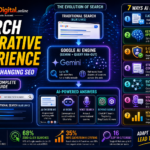
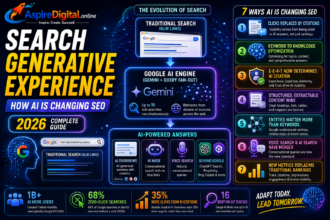
Everything covered in our guide on the Search Generative Experience applies directly here — GEO is not a separate discipline from white hat SEO. It is white hat SEO applied to a new surface.
How to apply this: Start every post section with a clear, directly quotable 1–2 sentence answer. Include at least one comparison table in every comprehensive guide. Write FAQ sections with questions phrased as natural spoken language. Add structured data (Schema markup) using RankMath to give AI systems machine-readable signals about your content’s structure and authorship.
White Hat vs Black Hat — Full Comparison Table
| Practice | White Hat SEO | Black Hat SEO | Risk Level |
|---|---|---|---|
| Content creation | Original, helpful, expert-written content | Mass AI-generated spam, thin duplicated content | 🔴 High penalty risk for black hat |
| Link building | Earned editorial links, guest posts, digital PR | Buying links, PBNs, link farms | 🔴 Manual penalty risk for black hat |
| Keywords | Natural keyword usage, semantic enrichment | Keyword stuffing, hidden text, cloaking | 🔴 Algorithmic penalty for black hat |
| Technical optimization | Site speed, Core Web Vitals, schema markup | Sneaky redirects, doorway pages | 🔴 Deindexing risk for black hat |
| Long-term result | Compounding authority and rankings | Temporary gains, catastrophic drops | 🔴 Total loss of investment for black hat |
| AI search visibility | Earned citations from genuine expertise | No citations — AI systems filter manipulation | 🔴 Zero AI visibility for black hat |
Common White Hat SEO Mistakes to Avoid
Treating white hat SEO as “slow SEO.” This is the most damaging misconception. White hat SEO does take longer than a black hat shortcut to show results — but it compounds exponentially over time rather than collapsing. A white hat site six months old consistently outperforms a black hat site that launched simultaneously and got quick early gains but was penalized.
Using AI to write content and publishing without meaningful human revision. Using AI as a drafting tool is fully consistent with this approach — but publishing AI output without adding genuine human expertise, original examples, and editorial oversight is not. Google’s Helpful Content system is increasingly effective at identifying content that has not been meaningfully improved by real human knowledge. The experience and expertise must genuinely exist and show through.
Chasing backlinks without earning them. Cold outreach with an 8% success rate, mass directory submissions, and irrelevant guest posts on low-quality sites are not white hat SEO — they are grey hat at best. White hat link building means creating something genuinely worth linking to and then reaching the right people who would benefit from referencing it.
Ignoring technical SEO while focusing entirely on content. Content without a solid technical foundation underperforms consistently. A site with excellent content but poor Core Web Vitals, broken internal links, and slow mobile loading will always be outranked by a slightly less impressive site that loads in 1.2 seconds and is perfectly crawlable.
Optimizing for rankings rather than for the human being searching. This is the core mistake white hat SEO is specifically designed to prevent. When you optimize for the human first — answering their real question completely, making their experience as smooth and valuable as possible — the rankings follow. When you optimize for the ranking first, you typically produce content that looks good to crawlers but fails real users.
Expert Tips from Building 30+ Websites
Tip 1 — Apply the 80/20 rule to your your SEO efforts. Roughly 20% of your efforts produce about 80% of your results. In practice, that usually means: fix critical technical issues, improve your most important pages, build internal links, and refresh near-ranking content. These four moves tend to deliver the highest return, especially compared to publishing large volumes of low-impact content. After building 30+ websites, this pattern holds consistently across every niche and site size.
Tip 2 — Update existing content before creating new content. Most sites have pages sitting in positions 6–15 that could move to positions 1–5 with targeted improvements — better intent match, stronger on-page optimization, fresher data, additional internal links from newer posts. Identifying and improving these near-ranking pages delivers faster results than starting new posts from scratch, because Google’s trust signals for the existing URL are already built.
Tip 3 — Build your internal linking intentionally from day one. The most common technical mistake on new blogs is treating internal links as an afterthought. Every new post you publish should link back to 2–3 of your most important existing posts, and your most authoritative existing posts should be updated to link forward to relevant new content. This distributes authority across your entire content cluster and helps Google understand the topical relationships between your posts.
Tip 4 — Document your white hat results to build even more authority. Publishing original case studies, before-and-after data from your own website, and real-world results from your client work serves two purposes simultaneously: it demonstrates the firsthand experience that E-E-A-T rewards, and it creates the kind of data-driven, original content that earns natural backlinks and AI citations. Your real results are your most powerful white hat content asset.
Tip 5 — Be patient with authority building, but urgent with technical fixes. The two most common timing mistakes in white hat SEO are giving up on content and link building too early (expecting results in weeks rather than months), and delaying technical fixes indefinitely (treating Core Web Vitals as a future problem). The correct approach: fix technical issues immediately because the returns are fast, and commit to content and authority building for the long term because the compounding returns are extraordinary.
Frequently Asked Questions
What is white hat SEO in simple terms?
White hat SEO is the practice of improving your website’s search rankings using ethical, Google-approved strategies — creating genuinely helpful content, earning real backlinks, optimizing your technical setup, and building authentic authority. It follows search engine guidelines rather than trying to exploit loopholes, and it builds rankings that compound over time rather than collapsing when algorithms update.
What is the difference between white hat and black hat SEO?
White hat SEO follows Google’s guidelines and prioritizes genuine user value — helpful content, earned links, clean technical optimization. Black hat SEO deliberately violates guidelines to manipulate rankings — keyword stuffing, purchased links, PBNs, cloaking, and AI-generated spam content. White hat builds compounding authority over time. Black hat delivers short-term gains followed by algorithm penalties that can destroy a site’s entire search visibility overnight.
Does white hat SEO really work in 2026?
Yes — more reliably than ever. Sites penalized by Google’s 2026 core updates saw 40–60% traffic drops overnight, while white hat sites maintained or strengthened their positions. The rise of AI search has made white hat SEO even more important: AI systems cite sources with genuine expertise and real trust signals — exactly what white hat SEO builds. Success in 2026 is not about outsmarting the algorithm — it is about being the most cited human expert in the room.
How long does white hat SEO take to show results?
Technical SEO fixes can show results within days to weeks. On-page content improvements typically take 4–12 weeks. Building topical authority through content clusters takes 3–6 months. Link building authority compounds over 6–18 months. GEO citations can appear within weeks of publishing well-structured, expert-backed content. The investment timeline is longer than black hat shortcuts — but the results compound rather than collapse.
Is guest posting white hat SEO?
Yes — when done correctly. Publishing genuinely useful, expert-written articles on relevant, reputable sites with real editorial standards is fully compliant white hat link building. What makes it grey or black hat is publishing thin, keyword-stuffed posts purely for link placement on low-quality sites that exist only to sell links. The distinction is simple: genuine value for the audience of the site you are publishing on, versus pure manipulation of link metrics.
Is using AI to write content black hat SEO?
No — using AI as a drafting and research tool is consistent with this approach. Google does not penalize AI-assisted writing. What Google penalizes is content that adds no genuine value — thin, generic, unedited AI output that simply restates publicly available information without real expertise, original insight, or meaningful human revision. AI plus genuine human expertise and editorial oversight equals acceptable white hat content. AI replacing human expertise entirely equals thin content that underperforms.
What are the most effective white hat SEO tactics in 2026?
The 9 most effective white hat SEO strategies in 2026 are: intent-driven keyword research, helpful and experience-driven original content, proper on-page optimization, solid technical SEO foundations, ethical link building through digital PR and guest posting, E-E-A-T and author authority signals, topical authority through content clusters, user experience optimization, and generative AI search optimization (GEO).
Conclusion
This approach has never been a limitation — it has always been the strategy. The ethics and the effectiveness are not in tension. They are the same thing, expressed in practice.
Google’s entire purpose is to surface the most genuinely useful, trustworthy, and relevant content for every search query. The sites that win — and keep winning, through every algorithm update, every AI integration, every search landscape shift — are the ones that align their entire strategy with that same purpose.
This approach is not a choice between ethical and effective. It is the only sustainable strategy across every search surface — Google, ChatGPT, Perplexity, and emerging AI platforms. The algorithms have aligned. Expertise, original research, transparent sourcing, and real authority compound together.
Build your site the right way. Create content that genuinely deserves to rank. Earn the links, the citations, and the trust that compound over time. And then watch as every algorithm update that destroys your competitors strengthens your position — because what you have built is something no shortcut can replicate.
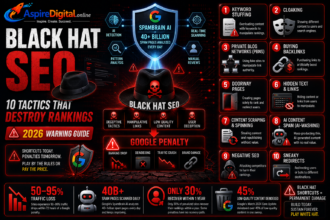
In the next guide on AspireDigital, we go deep into Black Hat SEO — what it is, how it works, and exactly why it fails — so you can identify and avoid these tactics with complete confidence. If you have not yet read our guide on SEO ranking factors, that is the perfect companion to everything covered here.
About the Author
Tarun is a Digital Marketing Specialist and WordPress Developer with 3+ years of hands-on experience helping businesses grow online. He has built 30+ real-world websites and delivered digital marketing services across industries including healthcare, hospitality, enterprise services, visa consulting, wellness, and more. Through AspireDigital.online, Tarun shares practical, no-fluff digital marketing strategies to help creators, freelancers, and business owners thrive in the digital world.
🔗 Portfolio | Instagram | LinkedIn