Last Updated: June 2026 | Author: Tarun | Read Time: 14 min
Table of Contents
- Key Takeaways
- Introduction
- What is Search Generative Experience?
- AI Overviews vs AI Mode — What’s the Difference?
- How Query Fan-Out Actually Works
- Change 1 — Clicks Are Being Replaced by Citations
- Change 2 — Keyword Optimization is Becoming Knowledge Optimization
- Change 3 — E-E-A-T Now Determines AI Citation, Not Just Ranking
- Change 4 — Structured, Extractable Content Wins
- Change 5 — Entities Matter More Than Keywords
- Change 6 — Voice Search and AI Search Have Merged
- Change 7 — New Metrics Are Replacing Traditional Rankings
- What Google Itself Says You Should Do
- Mistakes That Actively Hurt Your AI Visibility
- SEO vs GEO vs AEO — Quick Comparison
- Expert Tips to Win in the Search Generative Experience
- Frequently Asked Questions
- Conclusion
Key Takeaways
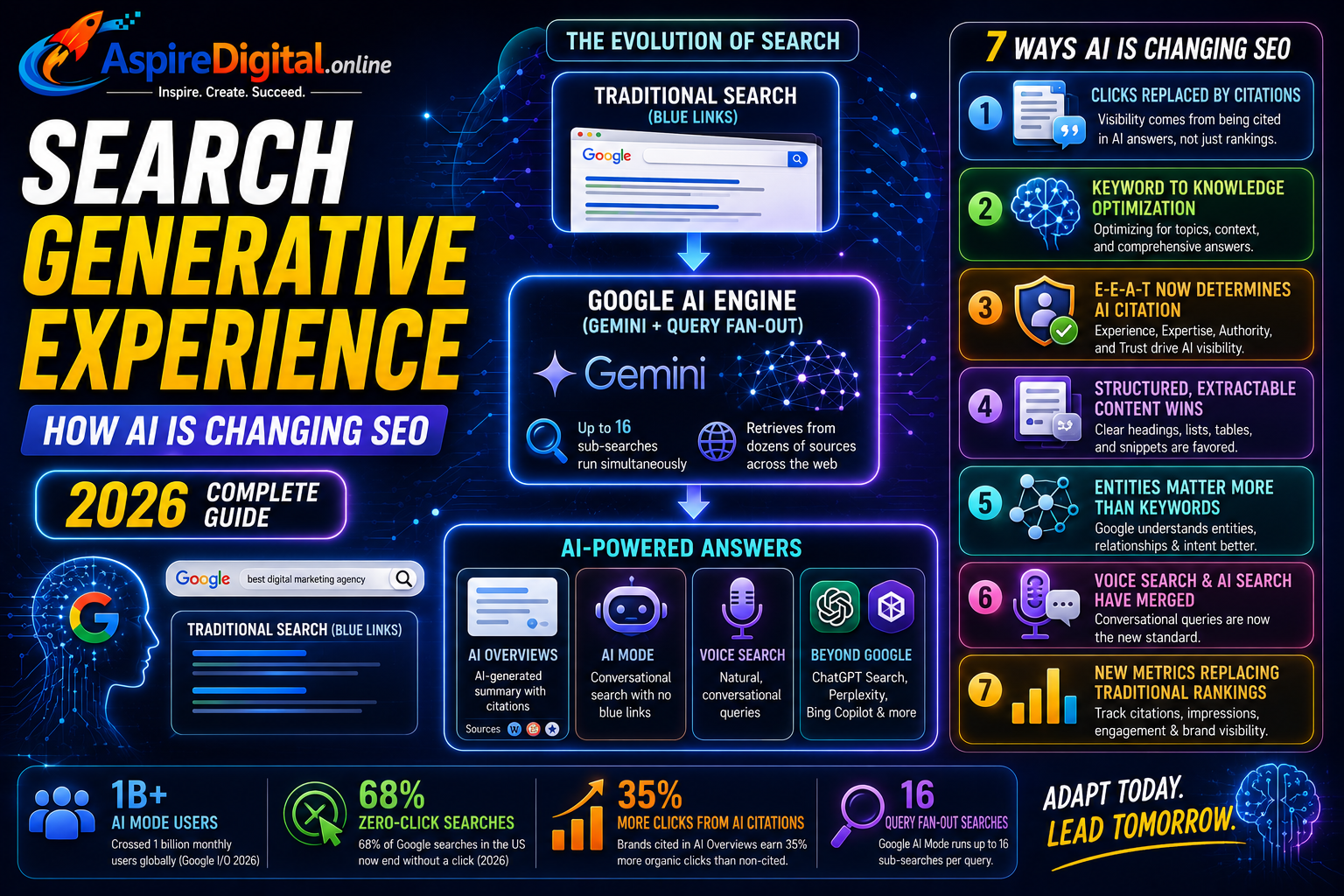
- Search Generative Experience (now branded AI Mode and AI Overviews) has crossed 1 billion monthly users globally as of Google I/O 2026, fundamentally changing how people search.
- 68% of Google searches in the US now end with zero clicks to any external website — meaning being cited matters more than being clicked.
- Brands cited inside AI Overviews earn 35% more organic clicks than non-cited competitors, making AI citation a direct revenue driver, not just a visibility metric.
- Google’s own official May 2026 guidance confirms: AEO and GEO are not separate disciplines — they are foundational SEO applied to an AI surface.
- AI Mode runs up to 16 sub-searches per query using a technique called “query fan-out,” synthesizing one comprehensive answer from dozens of sources.
Introduction
On April 29, 2026, Google quietly removed the “Search” button from Android devices and replaced it with “Ask Google.” The iconic Google logo disappeared from that spot. It sounds like a small interface tweak. It is not. It is the clearest signal yet that the way people find information online has been permanently restructured.
This is the Search Generative Experience — Google’s shift from a list of ranked blue links to AI-generated, conversational answers powered by Gemini. And if you publish content online, this single shift changes nearly everything about how SEO works in 2026.
The numbers tell the story clearly. AI Mode crossed 1 billion monthly users in its first year, with queries doubling every quarter. Meanwhile, 68% of Google searches in the US now end without a single click to an external website. Traditional SEO tactics — keyword stuffing, chasing page-one rankings, optimizing purely for clicks — no longer guarantee visibility the way they once did.
But here is the good news: SEO is not dead. It has evolved. In this guide, we break down exactly what Search Generative Experience is, how it actually works under the hood, and the 7 fundamental ways it is changing SEO in 2026 — backed by Google’s own official guidance published just weeks ago. If you have not yet read our guide on E-E-A-T SEO, read that first, because E-E-A-T is the foundation everything in this guide builds on.
What is Search Generative Experience?
Search Generative Experience (SGE) refers to Google’s AI-powered search features — primarily AI Overviews and AI Mode — that use generative AI to synthesize direct answers from multiple web sources instead of simply returning a ranked list of links. SGE was the original development codename; it is now publicly known as AI Overviews and AI Mode.
Powered by Google’s Gemini model combined with Google’s search index and Knowledge Graph, the Search Generative Experience analyzes a user’s query, retrieves relevant content from across the web, and generates a synthesized, conversational response with citations back to its sources — all in place of, or alongside, traditional search results.
This is not a minor algorithm update. According to Google’s own Search team, this represents the company’s biggest search upgrade in 25 years. As of May 2026, AI Mode is now the default search experience for users globally, not an optional tab buried in Search Labs.
AI Overviews vs AI Mode — What’s the Difference?
These two terms are often used interchangeably, but they function differently — and understanding the distinction matters for how you optimize your content.
AI Overviews are static AI-generated summary boxes that appear above traditional search results for certain informational queries. Users can still see and click through traditional organic results alongside the AI Overview. Google’s own documentation confirms AI Overviews are only shown when the system determines they are additive to classic search — meaning they don’t trigger for every query.
AI Mode is a fully conversational search experience. There are no traditional blue links below an AI Mode response — you either get cited in the generated answer, or you do not appear at all. Users can ask follow-up questions without starting a new search, making the entire experience feel closer to chatting with ChatGPT than using a classic search engine.
The practical difference for you as a content creator: in AI Overviews, ranking organically still gives you a fallback visibility option. In AI Mode, citation is the only form of visibility that exists.
How Query Fan-Out Actually Works
Query fan-out is the core technique powering both AI Overviews and AI Mode. Instead of running your exact search query once, the system breaks it into multiple related sub-queries — Google AI Mode runs up to 16 sub-searches simultaneously — retrieves content from dozens of sources across all of them, and synthesizes a single comprehensive answer citing the sources it trusts most.
This is large-scale Retrieval-Augmented Generation, or RAG — a technique Google’s own documentation describes as “grounding,” used specifically to improve the quality, accuracy, and freshness of AI-generated responses.
Here is what this means practically: if someone searches “best digital marketing strategy for a small business in Hyderabad,” AI Mode does not just match those keywords. It might internally generate sub-queries like “digital marketing channels for small business,” “Hyderabad local SEO strategy,” “low-budget marketing tactics 2026,” and “small business marketing case studies” — then pull the most trustworthy answer from across all of them into a single synthesized response.
This is precisely why keyword-matching alone no longer works. Your content needs to comprehensively answer not just the exact query, but the broader cluster of related sub-questions a searcher might actually have.
Change 1 — Clicks Are Being Replaced by Citations
The single biggest shift in 2026 SEO is this: the goal is no longer just to rank — it is to be cited. With AI Overviews active, click-through rate on the number one organic result drops by approximately 58%, and 68% of all Google searches in the US now end without any click at all.
This sounds alarming, but the data reveals something more nuanced. Brands that are cited inside AI Overviews earn 35% more organic clicks than competitors who are not cited at all. The traffic landscape has not simply shrunk — it has redistributed toward sources that AI systems trust enough to cite.
What this means practically is that “ranking” and “winning” are no longer the same thing. A page sitting in position 3 that gets cited inside the AI Overview may now generate more total visibility and clicks than a page sitting in position 1 that does not get cited.
What to do: Start tracking impressions alongside clicks in Google Search Console — rising impressions with flat or falling clicks often indicates AI Overview presence, not a content failure. Add AI citation tracking to your reporting using tools like Semrush’s AI Overviews feature or Ahrefs’ AI Overview tracking.
Change 2 — Keyword Optimization is Becoming Knowledge Optimization
Generative AI systems do not match keywords the way traditional search engines do. They tokenize your content, convert it into vector space, find semantically relevant passages across multiple sources, and synthesize a coherent answer — meaning your page can be cited even if a user never clicks through to it.
In short: how AI search is changing SEO comes down to this — stop optimizing for keywords, and start optimizing for knowledge. Keyword density has become functionally irrelevant. What matters now is information density — how much genuinely useful, accurate, comprehensive knowledge your content actually contains on a topic.
Google’s own official guidance, published in May 2026, makes this explicit: creating content that people find unique, compelling, and useful will influence your visibility in generative AI search far more than any technical optimization trick.
What to do: Shift your content strategy from “what keyword am I targeting” to “what does someone need to fully understand about this topic.” Cover sub-questions, related concepts, and practical applications comprehensively — not just the primary search term.
Change 3 — E-E-A-T Now Determines AI Citation, Not Just Ranking
AI Mode prioritizes content from sources that demonstrate clear authority on a topic — including author credentials, external mentions, and consistent topical coverage over time. E-E-A-T has always mattered for traditional rankings, but it now directly determines whether AI systems trust your content enough to cite it.
An article signed “Staff Editorial” with no identifiable author carries dramatically less weight in AI citation decisions than one signed by a verifiable professional with linked credentials. AI models specifically look for identifiable authors with bios, links to professional profiles, and citations in third-party media as core trust signals.
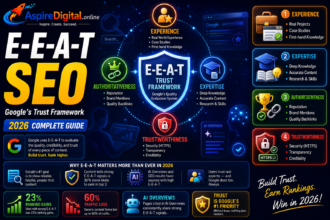
This connects directly to everything covered in our complete E-E-A-T SEO guide — the same Experience, Expertise, Authoritativeness, and Trustworthiness signals that improve traditional rankings are now the primary filter AI systems use to decide what gets cited.
What to do: Make sure every post has a real, credentialed, identifiable author with a detailed bio and links to verifiable professional profiles. This is no longer optional — it is foundational to AI visibility.
[ADD IMAGE HERE — Suggested alt text: “Search Generative Experience AI citation E-E-A-T author signals”]
Change 4 — Structured, Extractable Content Wins
AI Mode extracts specific claims and direct answers from your content. Pages that bury their answers inside long, narrative paragraphs are significantly less likely to be cited than pages that lead with clear, direct statements. Research found that comparison pages with three tables earn 25.7% more citations than pages without structured comparisons.
This is a fundamental shift in how content needs to be written. Traditional blog writing often builds up to an answer through storytelling and gradual explanation. AI-optimized writing front-loads the direct answer, then provides supporting context and nuance afterward.
This is exactly why every blog on AspireDigital now opens each major section with a bolded, direct 1-2 sentence answer before expanding into detail — this is not a stylistic choice, it is a structural requirement for AI extractability in 2026.
What to do: Lead every section with a clear, standalone, directly quotable answer. Use comparison tables wherever relevant. Use bullet points and numbered lists for processes and multi-part answers. Write content that could be lifted as a standalone snippet and still make complete sense.
Change 5 — Entities Matter More Than Keywords
AI models do not just read keywords — they recognize entities: people, companies, products, places, and concepts connected through Google’s Knowledge Graph. Using the proper names and recognized technical terms — rather than vague keyword variants — significantly improves your chances of being correctly understood and cited.
This means your content should reference specific, real, named entities naturally: actual tools (RankMath, Google Search Console, SEMrush), actual concepts (Core Web Vitals, E-E-A-T, query fan-out), and actual organizations (Google Search Central, specific publications) rather than generic descriptions.
Topic clusters also play a direct role here. Linking related content internally and structuring your site around comprehensive topic coverage — rather than isolated keyword-targeted posts — helps AI systems recognize your site as topically authoritative on specific entities and subjects.
What to do: Use specific, recognized entity names throughout your content instead of vague paraphrases. Build internal links between related posts to reinforce topical clusters. Reference real tools, studies, and organizations by name.
Change 6 — Voice Search and AI Search Have Merged
Voice search now accounts for roughly 30% of all AI answer engine interactions, and it is powered by the exact same generative answer layer as text-based AI search. Siri, Google Assistant, and Alexa now pull from the same citation logic that powers AI Overviews and AI Mode.
This means the practical overlap between traditional voice search optimization and Generative Engine Optimization (GEO) is now nearly complete. If your content is properly structured to be cited in a text-based AI answer, it is almost certainly also structured well for voice delivery.
Specific technical recommendations for this merged voice/AI layer include conversational heading structure (headings phrased as natural spoken questions, not keyword strings), Q&A formatting throughout your content, and shorter sentence length — under 20 words — in sections most likely to be extracted as a direct voice response.
What to do: Phrase your H2 and H3 headings as natural questions a person would actually ask out loud. Follow each heading immediately with a short, direct, spoken-language answer before expanding into detail.
Change 7 — New Metrics Are Replacing Traditional Rankings
Traditional rank tracking is no longer sufficient on its own. New metrics specific to generative AI SEO are emerging as the primary indicators of success: AI Citation Frequency, AI Share of Voice, Prompt-Level Visibility Rate, and AI-Referred Sessions tracked as a distinct traffic channel in GA4.
AI Citation Frequency measures how often your brand is cited across AI responses for your target topics. AI Share of Voice measures what percentage of relevant AI responses mention you versus your competitors in your category. Prompt-Level Visibility Rate tracks how consistently you are cited for each of your priority topics or questions. AI-Referred Sessions tracks actual traffic arriving from ChatGPT, Gemini, Perplexity, and Claude as separate, trackable channels.
Google itself confirmed that sites appearing in AI features are included in overall search traffic data within Search Console’s Performance report, under the “Web” search type — meaning rising impressions with flat clicks is now a measurable, trackable signal of AI Overview presence rather than a content failure.
What to do: Set up custom channel grouping in GA4 to separately track AI-referred sessions from ChatGPT, Perplexity, and Gemini. Monitor your Search Console impressions-to-clicks ratio over time — a widening gap often signals growing AI Overview presence, which is a positive sign, not a negative one.
What Google Itself Says You Should Do
On May 15, 2026, Google published its first consolidated official guide on optimizing for generative AI features in Search, announced by John Mueller of the Search Relations team. The central message from Google directly: there is no separate strategy for AI search — AEO and GEO are foundational SEO applied to an AI surface.
Google’s guide identifies five specific areas that support AI visibility:
- Unique, non-commodity content — Generic summaries that AI can generate itself add no citation value. Only content reflecting genuine expertise, original research, or firsthand experience earns inclusion.
- Local and shopping optimization — Google Merchant Center feeds and Google Business Profiles directly influence what appears in AI responses for product and local service queries.
- Content organized for human readers — Well-structured paragraphs, sections, and headings that provide clear navigation, written primarily for people, not algorithms.
- High-quality images and video — Supporting your textual content with relevant visuals creates additional opportunities to appear beyond text citations.
- Technical accessibility — Ensuring crawling is allowed in robots.txt and your content is easily discoverable through clear internal linking.
Importantly, Google’s own documentation confirms there is no special schema markup, AI text file, or machine-readable format required specifically for AI Overviews or AI Mode — the existing SEO fundamentals are what matter. You can review this directly on Google Search Central’s official AI optimization guide.
Mistakes That Actively Hurt Your AI Visibility
Publishing AI-generated content without human revision. Generative AI models are increasingly good at recognizing generic, templated text. Without genuine voice, real experience, and original data, AI-generated content will not be cited — and risks active E-E-A-T penalties in traditional rankings too.
Keyword stuffing. AI Mode specifically penalizes over-optimization. Keyword density is functionally irrelevant in 2026 — information density is what actually counts toward citation.
Writing encyclopedia-style content without perspective. A neutral, generic “what is cloud computing” article will not get cited. Content that says “in our project, this approach reduced costs by 34%” — with real specificity and original data — will.
Ignoring structured data and clear formatting. Structured, scannable content is one of the few technical signals that RAG-based pipelines read directly and reliably. Burying your content in unstructured paragraphs leaves an entire visibility channel completely unused.
Treating AEO and GEO as separate from SEO. Google’s own official guidance is explicit: there is no separate playbook. Trying to “hack” AI visibility with shortcuts while ignoring core SEO fundamentals — helpful content, technical health, E-E-A-T — will not work, because AI features are rooted in Google’s same core ranking and quality systems.
SEO vs GEO vs AEO — Quick Comparison
| Discipline | Primary Goal | Where It Shows Up | Key Success Metric |
|---|---|---|---|
| Traditional SEO | Rank in organic search results | Classic blue links, Google Maps | Ranking position, organic clicks |
| AEO (Answer Engine Optimization) | Win featured snippets and voice answers | Position zero, voice assistants | Snippet capture rate |
| GEO (Generative Engine Optimization) | Get cited inside AI-generated answers | AI Overviews, AI Mode, ChatGPT, Perplexity | AI citation frequency, AI share of voice |
As Google itself states, these are not three separate disciplines requiring three separate strategies — they are three surfaces that the same foundational SEO best practices feed into simultaneously.
Expert Tips to Win in the Search Generative Experience
Tip 1 — Audit your top-performing pages for AI extractability first. Before creating new content, go back through your highest-traffic existing posts and check whether each section opens with a clear, directly quotable answer. Most existing blog content was written for human narrative flow, not AI extraction — this single fix on existing content often produces faster results than publishing new posts.
Tip 2 — Treat your author bio as a citation-readiness asset, not decoration. Since AI Mode actively evaluates author credentials when deciding what to cite, a detailed, credentialed, linked author bio on every post is now a direct ranking and citation lever — not just an E-E-A-T nicety. Every post on AspireDigital includes this for exactly this reason.
Tip 3 — Build comparison tables wherever genuinely relevant. With data showing comparison pages with three tables earning 25.7% more citations, structured comparisons are one of the highest-leverage, lowest-effort content additions you can make. Look for natural comparison opportunities in every topic you cover.
Tip 4 — Stop measuring success by rank alone. Start tracking your impressions-to-click ratio in Search Console over time. A widening gap — rising impressions, flat or declining clicks — is increasingly a signal of growing AI Overview presence, not a content failure. Layer in AI citation tracking tools to get the full picture.
Tip 5 — Write for the follow-up question, not just the first one. Since AI Mode queries run 2-3 times longer than traditional searches and support conversational follow-ups, structure your content to anticipate and answer the natural next question a reader would have — not just the primary search term they started with.
Frequently Asked Questions
What is Search Generative Experience in simple terms?
Search Generative Experience refers to Google’s AI-powered search features — now publicly known as AI Overviews and AI Mode — that use generative AI to create direct, synthesized answers from multiple web sources, instead of just showing a ranked list of links.
What is the difference between AI Overviews and AI Mode?
AI Overviews are static AI-generated summary boxes shown above traditional search results, with organic results still visible alongside them. AI Mode is a fully conversational search experience with no traditional blue links — you are either cited in the generated answer or you do not appear at all.
Does SEO still matter with Search Generative Experience?
Yes, significantly. Google’s own official May 2026 guidance confirms that AI features are rooted in the same core Search ranking and quality systems as traditional SEO. There is no separate strategy required — strong foundational SEO, helpful content, and E-E-A-T signals directly determine AI visibility too.
How do I get my content cited in AI Overviews and AI Mode?
Focus on publishing unique, non-commodity content that reflects genuine expertise or firsthand experience, structure your content with clear direct answers and comparison tables, build strong E-E-A-T signals including credentialed author bios, and ensure your technical SEO fundamentals — crawlability, site structure, internal linking — are solid.
Is zero-click search bad for my website?
Not necessarily. While 68% of searches now end without a click, brands cited inside AI Overviews earn 35% more organic clicks than non-cited competitors. The traffic has redistributed toward trusted, cited sources rather than disappearing entirely. Being cited is now often more valuable than ranking in position one without citation.
What is query fan-out?
Query fan-out is the technique Google AI Mode uses to answer searches — instead of running your exact query once, it runs up to 16 related sub-searches simultaneously, retrieves content from dozens of sources across all of them, and synthesizes one comprehensive answer with citations to the most trustworthy sources.
Do I need special schema markup for AI Overviews or AI Mode?
No. Google’s official documentation explicitly states there is no special schema.org structured data required specifically for AI Overviews or AI Mode. Standard SEO fundamentals — clear content structure, proper crawlability, and helpful, well-organized content — are what matter most.
Conclusion
The Search Generative Experience is not a temporary feature or an experiment anymore. With AI Mode crossing 1 billion monthly users and Google officially confirming this is its biggest search upgrade in 25 years, the shift from ranked links to AI-generated answers is the new permanent reality of search.
But the most important thing to understand — confirmed directly by Google’s own official guidance — is that this is not a separate game requiring a separate playbook. The fundamentals that have always mattered for great SEO — genuine expertise, helpful content, strong E-E-A-T signals, clean technical structure — are exactly what determines AI citation too.
The brands and creators who will struggle in this new era are the ones still chasing keyword density and thin, generic content. The ones who will thrive are the ones who lean into real experience, original insight, and content structured clearly enough that both humans and AI systems can extract genuine value from it.
Build for both. Write content so good and so clearly structured that it deserves to be cited — and the citations, the clicks, and the rankings will follow together. If you have not yet read our guide on SEO ranking factors, it pairs perfectly with everything covered here.
About the Author
Tarun is a Digital Marketing Specialist and WordPress Developer with 3+ years of hands-on experience helping businesses grow online. He has built 30+ real-world websites and delivered digital marketing services across industries including healthcare, hospitality, enterprise services, visa consulting, wellness, and more. Through AspireDigital.online, Tarun shares practical, no-fluff digital marketing strategies to help creators, freelancers, and business owners thrive in the digital world.
🔗 Portfolio | Instagram | LinkedIn